
How much money do influencers make
The rate is knowable. The income is not, and anyone who gives you an annual figure by follower count has multiplied a real number by a guess.
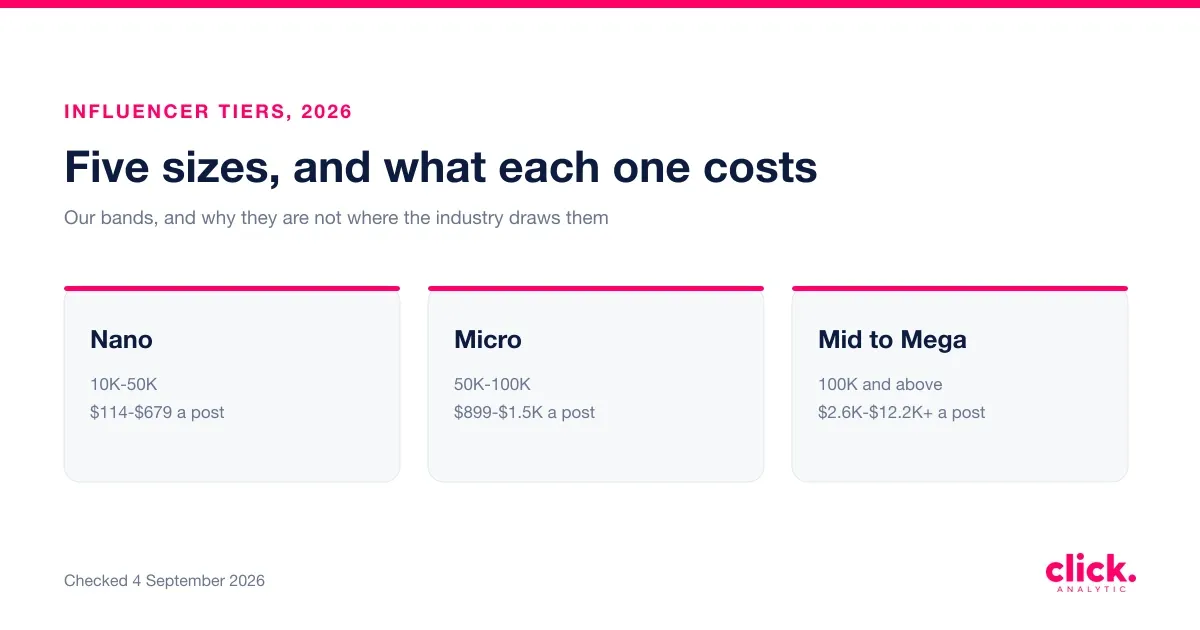
Here is the part we can measure: what one Instagram feed post is worth, by size.
| Follower band | One feed post | 5 posts a year | 20 posts a year |
|---|---|---|---|
| Nano, 10K to 50K | $114 to $679 | $570 to $3,400 | $2,300 to $13,600 |
| Micro, 50K to 100K | $899 to $1,500 | $4,500 to $7,500 | $18,000 to $30,000 |
| Mid, 100K to 500K | $2,600 to $5,700 | $13,000 to $28,500 | $52,000 to $114,000 |
| Macro, 500K to 1M | $5,900 to $12,200 | $29,500 to $61,000 | $118,000 to $244,000 |
| Mega, 1M and above | $12,200 and above | $61,000 and above | $244,000 and above |
Read the columns, not the rows. The number of deals is the variable, and it is the one nobody can give you. Two creators in the same band, with the same audience, can be twenty deals apart in a year.
And the honest floor is lower than any table suggests. Most accounts sell nothing at all: only 35% of United States accounts between 10,000 and 50,000 followers have any detected paid post in their history. For those creators the correct annual figure is zero, and no follower count changes that.
Followers are not income. They are inventory. A follower count is what you have to sell. Whether anyone buys it, how often, and at what rate are three separate questions, and this page is about all three.
How many influencers actually get paid for a post
This is our own count, not a survey. We looked at every United States Instagram account above 10,000 followers in our database and asked one question: is there a sponsored post anywhere in this account's history?
| Follower band | Any detected paid post | Median engagement | Price per feed post |
|---|---|---|---|
| Nano, 10K to 50K | 35% | 0.80% | $114 to $679 |
| Micro, 50K to 100K | 45% | 0.73% | $899 to $1,500 |
| Mid, 100K to 500K | 54% | 1.02% | $2,600 to $5,700 |
| Macro, 500K to 1M | 64% | 1.10% | $5,900 to $12,200 |
| Mega, 1M and above | 73% | 1.20% | $12,200 and above |
Two things follow from that second column.
Reaching 10,000 followers does not put you in the market. Roughly two thirds of accounts in the smallest band have never had a paid post we can detect. Follower count is the entry ticket to being findable, not to being paid.
The gap narrows with size but never closes. More than a quarter of accounts above one million followers still show no sponsored history.
Our own read: the thing that predicts whether a creator gets paid is not follower count, it is whether a brand can tell what the account is about in five seconds. Accounts with one clear subject get bought at 20,000 followers. Accounts with no subject stay unbought at 500,000. If you want the size labels themselves, we set out where our bands break and why in types of influencers.
How many followers you need before anyone pays you
None, for some of it.
The routes that need no audience at all are the ones most working creators start with. UGC is content made for a brand's own channels, so the brand is buying the film, not your reach. Affiliate links pay on sales, not on followers. Local businesses buy proximity, not scale.
Ways to earn before 10,000 followers:
- UGC for a brand's own channels, where you never post it yourself.
- Affiliate links and creator codes, paid on tracked sales.
- Product photography and video, sold as production rather than promotion.
- Local business work, where a shop wants the neighbourhood, not the country.
- Freelance services in the skill the account demonstrates.
- Digital products sold to whoever is already listening.
- Subscriptions, which need a small committed audience rather than a large one.
Where the thresholds do exist, they are platform payouts: 10,000 followers for TikTok Creator Rewards, 1,000 subscribers for the YouTube Partner Program. Instagram has no threshold because it has no programme to qualify for.
And clearing 10,000 followers is not the same as being paid. Our own count found 35% of United States accounts in the 10,000 to 50,000 band with any detected paid post. The other two thirds crossed the threshold and sold nothing.
The three sources of influencer income: brands, audience, platforms
Every route below is one of three things.
- Brand money. A company pays you, in cash or in goods, to make or license something. The biggest line for almost every working creator.
- Audience money. Your followers pay you directly, through subscriptions, tips, products or courses.
- Platform money. The platform pays you a share of its own advertising or a reward for views.
Most guides stop at that list. The rest of this page is the part that actually decides what you earn: which format, on which platform, under which deal structure, and what you charge on top of it.
Instagram sponsorship formats, and what changes the price of each
The word "sponsored post" hides a dozen different products with very different prices.
| Format | What the brand buys | What moves the price |
|---|---|---|
| Feed post | One permanent image or carousel on your grid | Whether it stays up forever or comes down after 30 days |
| Reel | A short video, the highest-reach organic format | Views, not followers; production time; whether audio is original |
| Story frame | Three to five swipe-through frames, gone in 24 hours | Frame count, link sticker, whether it is saved to Highlights |
| Collab post | A post published to both your grid and the brand's, one engagement count | Your audience becomes theirs for that post; usually priced above a plain feed post |
| Live | A joint or solo live session with the product on camera | Duration, whether it is scheduled and promoted in advance |
| Partnership ad | The brand runs your post as a paid ad from your handle | Duration of the permission, and whether they can edit the caption |
| Product tag or affiliate | A shoppable tag on your own content | Usually commission only, not a fee |
Two of those need explaining, because they are where the money quietly is.
Collab posts put one piece of content on two grids with a shared like and comment count. For the brand that is reach plus social proof in one move. For you it means your followers see the brand's handle next to yours permanently.
Partnership ads are the big one. Instagram lets a creator issue a permission so an advertiser can run ads from the creator's own handle, and lists tools to create a partnership ad code, manage permissions at content or account level, and stop an advertiser running them. The ad looks like your post, carries your name, and reaches people who do not follow you, for as long as the brand keeps paying. That is a completely different product from one post to your own audience, and it should be a separate line on the invoice. We cover the mechanics in what whitelisting means in social media.
For what reach on Instagram is worth in platform terms, see how much Instagram pays for 1,000 views, and for building the reach itself, Reels engagement strategies.
TikTok sponsorship formats, from in-feed videos to Spark Ads
| Format | What the brand buys | What moves the price |
|---|---|---|
| In-feed sponsored video | One video on your account | Length, concept, how many reshoots are allowed |
| Spark Ads authorisation | Permission to run your organic video as a paid ad | Duration of the authorisation code, and the video stays locked while it runs |
| Branded Mission | A brief posted by a brand that many creators answer | You are competing, not booked; payment depends on selection |
| TikTok Shop affiliate video | A video with a product link, paid on sales | The seller sets the commission per product |
| LIVE shopping | Selling on camera in real time | Session length, and commission on what actually sells |
| Series | Paid content your own audience buys | Whether you have anything worth charging for |
Spark Ads is TikTok's version of whitelisting, and TikTok documents it precisely. Its help page, which TikTok dates to June 2026, says advertisers can publish ads using organic posts made by other creators, with their authorization, that the brand can "customize the duration of your authorization code", and that all engagement earned while boosted is attributed back to your original post.
One line in that page is worth the whole section: "Videos need to be un-authorized as a Spark Ad before it can be deleted from the organic account." While a brand's authorisation is live, you cannot delete your own video. Cap the duration in writing.
TikTok Shop affiliate work is its own economy: commission set by the seller per product, paid on delivered orders rather than views. We cover the creator side in the TikTok Shop affiliate program and the mechanics in how TikTok Shop works.
YouTube sponsorship formats, from pre-roll mentions to dedicated videos
YouTube pays differently because the content lasts. A video from three years ago is still selling.
| Format | What it is | Typical deal shape |
|---|---|---|
| Dedicated video | The whole video is about the product | Highest fee of any single deliverable |
| Integration | A 60 to 90 second segment inside a video about something else | Priced on the channel's average views, not subscribers |
| Pre-roll mention | Fifteen to thirty seconds before the content starts | Cheapest slot, often sold in bundles |
| Product placement | The product is present with no scripted read | Lower fee, sometimes gifting only |
| Description and pinned comment | A link and code below the video | Usually thrown in, sometimes affiliate only |
| Shorts | A vertical short with the product | Priced like TikTok, not like long-form |
The reason YouTube rates look high is that an integration keeps being watched. The reason they are hard to quote is that a channel's next video can do five times the views of its last one. Price on median views over the last ten videos, not on the best one.
Paid creator work that never gets posted: UGC, licensing, events
Some of the steadiest creator income never gets posted at all.
- UGC. You make content for the brand's own channels and never publish it yourself. No audience required, which is why it is the usual first paid work, and why it gets its own comparison below.
- Content licensing. A brand buys the right to reuse something you already posted. No new shoot, so it is close to pure margin.
- Ambassadorships. A retainer over months instead of a one-off fee, usually with exclusivity attached. See ambassador programs.
- Podcast and newsletter reads. Sold on audience size and read placement, and priced per thousand rather than per post.
- Events and appearances. Store openings, launches, trade shows, panels. A day rate plus travel, and completely separate from posting.
- Consulting and services. Running social for a brand, coaching other creators, or an agency built behind the account.
UGC creator or influencer: two different jobs, two different buyers
They are often confused because both make content for brands. What the brand pays for is not the same thing.
| Influencer | UGC creator | |
|---|---|---|
| Audience needed | Yes | No |
| Posted on your account | Usually | Usually not |
| The brand is buying | Reach and trust | The content itself |
| Followers matter | A great deal | Barely |
| Usage rights | Charged on top | Often the whole point |
| Good for starting out | Sometimes | Often |
This is why someone with 3,000 followers can out-earn someone with 30,000. The first sells production, which a brand needs every month. The second sells reach that may never have been bought.
If that is the route, start with how to become a UGC creator and applying to be a UGC creator.
Affiliate or sponsorship: paid for the work, or paid for the result
The difference is easiest to see as arithmetic.
A $1,000 sponsorship pays $1,000 when the post goes up. A 10% affiliate commission on the same product needs $10,000 of tracked sales to reach the same figure. If the audience does not buy, it pays nothing at all, and the work was the same.
Sponsorship pays for the content. Affiliate pays for the outcome. One caps your upside and removes your risk; the other does the reverse. Hybrid deals, a reduced fee plus commission, only make sense when the fee alone still covers what the shoot cost you.
We compare the two models in more depth in affiliate marketing versus influencer marketing.
Influencer deal structures: flat fee, CPM, affiliate, retainer, equity
The format decides what you make. The structure decides what you are paid.
| Structure | How it pays | Good for you when |
|---|---|---|
| Flat fee | One agreed price per deliverable | Almost always. Your risk is capped |
| Bundle | Several deliverables for one price | The bundle is priced up, not discounted to nothing |
| CPM or guaranteed views | A rate per thousand views, sometimes with a floor | Your views are consistent and you have a floor in writing |
| Affiliate or commission | A cut of tracked sales | Your audience buys, and the tracking window is long |
| Hybrid | A reduced fee plus commission | The fee alone still covers your production cost |
| Gifting or seeding | Free product, no fee | Almost never, unless the product is genuinely expensive |
| Retainer | Monthly payment for ongoing work | You want predictability and can live with exclusivity |
| Revenue share or equity | A share of the business | You would have taken the deal anyway and can wait years |
Gifting deserves its own warning. Free product is not free work: you still shoot, edit, post and answer comments. It also counts as a paid relationship under advertising law, which the next section covers.
If you are working out what to charge, our influencer price list sets out the bands, and what a micro influencer should charge per post goes into one tier in detail. Put the number in a media kit so you are not renegotiating it in a DM.
Followers, views or audience quality: what actually sets the price
A brand is not buying a number on a profile. It is buying a chance that a specific group of people sees something and acts.
| What a brand looks at | What it tells them |
|---|---|
| Average views | How many people actually see a post |
| Engagement rate | Whether the audience responds or scrolls |
| Audience country | Whether the audience can buy the product |
| Audience age and interests | Whether it is their customer |
| Past paid work | Whether you can deliver on a deadline |
| Link clicks | Whether attention turns into traffic |
| Followers | The size of the pool everything above is drawn from |
Follower count sits last on purpose. It is the only one of these a creator can inflate, and the only one that says nothing about what happens after the post goes up.
The sentence to keep: followers get you considered, views and audience quality get you priced, results get you rebooked.
That is why 100,000 followers in one country is not worth 100,000 in another. A brand selling in the United States pays for an American audience; the same follower count spread across markets it does not sell in is a smaller purchase. Our market data shows how far that varies: 86.9% of American creators have at least a fifth of their audience at home, against 29.7% of Swiss ones. You can search creators by country, topic and engagement rather than guessing at it.
What influencers charge on top of the post fee
This is where experienced creators earn twice what beginners do for the same post.
- Usage rights. Running your post as a paid ad is a different product from posting it. Price it separately and put an end date on it.
- Exclusivity. Not working with competitors for six months removes your other buyers. That is worth real money.
- Paid amplification. A brand putting media spend behind your content is buying reach through your name. Same principle as usage rights.
- Extra cutdowns. One shoot, five edits for five placements, is five deliverables.
- Approval rounds. Two rounds included, then a fee. Otherwise a cheap client can consume a week.
- Raw footage. Handing over unedited files is a separate sale.
Almost none of this is in a first offer. All of it belongs in writing before the shoot, which is what an influencer contract should cover.
How to disclose a paid partnership, and why free product counts
In the United States the FTC's guidance for creators is direct. A material connection includes "a financial relationship, such as the brand paying you or giving you free or discounted products or services". Free product is a paid relationship.
The same staff brochure is specific about how:
- Disclose even if you were not asked to mention the product.
- Put the disclosure with the endorsement, not in the bio and not behind a "more" click.
- Do not bury it in a block of hashtags.
- Do not use "sp", "spon" or "collab". Use "ad", "sponsored" or a plain sentence.
- In a video, say it in the video, not only in the description.
- In a live stream, repeat it, because most viewers arrive part way through.
- Do not rely on the platform's own paid-partnership label alone.
And the line that ends most arguments with a client: "You can't talk about your experience with a product you haven't tried."