Influencer Price List 2026: Instagram Rates by Follower Tier
Five Instagram price bands from 5.9M creators, how many creators sit in each band, and the fees that court records show real sponsored posts were paid.
By Jules CarmauxMarketing tips
Quick answer
One sponsored Instagram feed post runs from $114 to $679 at 10,000 to 50,000 followers up to $12.2K and more above a million, with three bands in between. The bands come from Click Analytic's pricing model across 5.9 million Instagram creators, a full-year 2025 snapshot.
They are planning estimates for one post, not quotes. There is no universal price list, because usage rights, exclusivity and the format move the number more than the follower count does, and because the creator you already know is rarely the cheapest good match in the niche.
Instagram influencer rates by follower tier
The five bands are our own model, not a survey of rate cards. They estimate the price of one sponsored feed post for human creators with at least 10,000 followers, from the 5.9 million Instagram accounts in the Creator Pricing Report 2026, which covers the whole of 2025. The full cohort, 23.6 million creators across Instagram, TikTok and YouTube, is described in the Creator Economy Report 2026.
Read a band as the range a fair first offer falls into, not as a creator's rate. A nano creator in a market with low advertising prices, average engagement and no reuse rights sits near the bottom. The same size of account in beauty, fitness or personal finance, with a clean audience and a history of posts that sold something, sits near the top or above it.
The model does not price five things, and no table can:
Creators below 10,000 followers.
Stories, Reels, TikTok videos, YouTube videos, Twitch streams or standalone UGC as separate lines.
Usage rights, paid amplification and exclusivity.
Production: filming, editing, travel, props, raw files, extra revisions.
Agency commission, taxes and payment fees.
Those items are what a quote is made of, and they are covered below. The band tells you where the conversation starts.
How many creators sit in each price band
A price list is half a market. The other half is how many sellers there are at each price, and that is a number we can count. On 3 September 2026 we ran five counting queries against the Click Analytic database for Instagram creators located in the United States, one per follower band.
Click Analytic data, September 2026.
Instagram accounts in the United States, by band:
10K to 50K: 1,001,846
50K to 100K: 156,437
100K to 500K: 151,926
500K to 1M: 18,367
1M and more: 14,346
Nearly three in four accounts that a brand could reasonably pay sit in the cheapest band. For every account above a million followers there are about 70 in the nano band. Worldwide the shape is the same: 7.2 million nano accounts against 67,261 above a million.
That is why the bottom of the list behaves like a market and the top does not. At $114 to $679 a brand can walk away from any single creator, because more than a million accounts sit in that band. Above a million followers there are 14,346 sellers in the whole country, most of them in a few categories, and the price is whatever the two sides agree.
The second count is the one we find more useful. For each band we also asked how many accounts already have at least one sponsored post in their history.
Click Analytic data, September 2026.
Share of accounts with at least one sponsored post, United States:
10K to 50K: 35%
50K to 100K: 45%
100K to 500K: 54%
500K to 1M: 64%
1M and more: 73%
Read the other way, 65% of the cheapest band has never been paid for a post. Some of those creators will quote low because they have no reference point, and some will quote high for the same reason. A creator with visible sponsored history has a number in mind, and it is usually closer to the band than a first-timer's guess.
Both counts are live database numbers, so they will not match the report's 2025 cohort exactly, and they include accounts the report's human-creator filter would remove. They are here to show the shape, and the shape is not close.
Pick creators by the niche's numbers, not by the one name you know
Most brands start a campaign with a creator in mind, usually the one they follow themselves. That is the most expensive place to start, for three reasons that have nothing to do with the creator's talent.
The audience is not theirs alone. The people who follow the creator you know also follow ten or twenty others in the same niche. Every niche has its own statistics across all of its accounts: how big the audiences are, where they live, how much they engage, how many sponsored posts they have already seen. The creator you noticed is one point in that distribution, and usually a point near the top of the price axis, because every other brand in the category noticed the same account.
Prices differ by niche, and not everyone knows the going rate. Established creators do; most of them have an agent or a rate card and a view of what the last five brands paid. But a large part of every niche is accounts that have only just started to grow: small, specific, followed for the craft. Woodwork, sourdough, vintage watches, a particular city's food, a particular sport's technique. Their audiences come every day because they like what the person makes. Many of those creators have never been offered a sponsored post, and their first one is priced very differently from a tenth.
We can count them. In the United States, the accounts that posted in the last 30 days, hold an engagement rate of 3% or more, and have no sponsored post detected anywhere in their history:
10K to 50K: 27,811
50K to 100K: 5,308
100K to 500K: 6,455
500K to 1M: 946
1M and more: 826
Source: Click Analytic database, counting queries run 3 September 2026, engagement rate of 3% or more, at least one post in the last 30 days, no sponsored post detected.
Twenty-seven thousand active, engaged nano accounts a brand could be the first to sponsor, in one country, on one platform. Those are the accounts where the creator has little or no history of sponsored content, has not yet fixed a rate, and where the band's lower half is a fair opening offer.
The practical method follows from the numbers. Filter the niche for where your buyers actually are: audience location, audience age, engagement, growth over the last months, sponsored history. Take fifty or a hundred accounts, not one; the right count depends on what you sell. Look at large and small accounts side by side, because the comparison is what tells you which is the better buy. A few small accounts with strong metrics, an audience that is still growing and a feed not yet crowded with sponsored posts often deliver more than one account whose sponsorship slots every brand has already used. The heavily sponsored account has a known, standard conversion, and a price that reflects the queue. The account you had to dig for has an engaged audience, a lower price, and a creator who wants the first deal to go well.
One creator or forty like them
The question a budget should answer is not "what does this creator cost" but "do I need this creator, or forty like them". The bands make the comparison concrete, with one more number from the same study base as the bands: the median engagement rate per tier (Click Analytic Creator Economy Report 2026, full-year 2025 snapshot).
10K to 50K: 0.80%
50K to 100K: 0.73%
100K to 500K: 1.02%
500K to 1M: 1.10%
1M and more: 1.20%
Take $12,000, as a simple illustration rather than a price claim. Option A is one creator priced at the top of the macro band, say 750,000 followers, one post. Option B is forty nano creators at $300 each, say 25,000 followers apiece, one post each. Using those medians, 1.10% for the macro band and 0.80% for the nano band, option A produces about 8,250 expected engagements and option B about 8,000. The engagement comes out within 3% either way.
The difference is everything else. Option B gives you forty pieces of content, forty audiences that barely overlap, forty chances to find the creator whose post sells, and forty contracts to manage. Option A gives you one asset, one audience and one negotiation over rights. Neither is cheaper. They buy different things.
What real sponsored posts cost, from court records
Rate cards are private. The prices that are public are the ones that ended up in a court order, a regulator's decision or a bankruptcy settlement, and nobody had to estimate them, because a party to the deal stated the number in a document a court or a regulator published.
Who
When
Followers
Fee
Kendall Jenner
2017
not stated
$275,000
Kim Kardashian
June 2021
225M
$250,000
Akon
Feb 2021
6.2M
$42,000
Jake Paul
Feb 2021
3.8M
$25,019
Ne-Yo
Feb 2021
6.6M
$12,000
Lindsay Lohan
Feb 2021
8.4M
$10,000
Kendra Lust
Feb 2021
1.2M
$955
Source: the SEC orders, the Fyre Festival bankruptcy settlement and the Italian competition authority decision linked below. Follower counts as stated in each document at the time of the post.
Kendall Jenner was paid $275,000 for one Instagram post promoting Fyre Festival in 2017. When the festival collapsed, the bankruptcy trustee sued to recover the fee, and she settled for $90,000 in May 2020 without admitting liability, as Bloomberg Law reported.
Kim Kardashian was paid $250,000 for one Instagram post about EMAX tokens on 13 June 2021, to about 225 million followers. The post carried #AD and not the amount. The SEC's order of 3 October 2022 had her pay $1.26 million, including a $1,000,000 penalty, and stay out of crypto promotion for three years.
Per million followers that is $6,774 for Akon and $796 for Kendra Lust, an 8.5 times spread for the same type of deliverable, one sponsored tweet for the same token. Lohan had the largest audience of the five and the second-lowest fee. If follower count set the price, those numbers could not exist. They exist because the price was set by who asked, who negotiated and what each side thought the name was worth. That is true at 25,000 followers too.
The largest figure in this list is not a per-post fee. Chiara Ferragni's companies received over 1 million euros for the licence and the Instagram content of the Balocco pandoro campaign of November 2022, and Italy's competition authority fined them 400,000 and 675,000 euros on 15 December 2023 because buyers were led to believe the purchase funded a donation that had already been made.
Prices that made no sense, and what each one taught
Every market has its stories. These five are documented, dated, and each one says something a price list cannot.
2.6 million followers, 36 shirts. In May 2019, Arii, an Instagram creator with 2.6 million followers, closed her clothing line ERA thirteen days after launch: the manufacturer required 36 units of each product sold in the first drop, and the orders did not come. A follower count is reach, and reach is not demand.
$60,000 for four posts, one delivered. Snap's PR agency paid Luka Sabbat $45,000 of a $60,000 fee for one feed post, three Stories and appearances in Spectacles at three fashion weeks in 2018. He posted once, was sued for $90,000 and settled in August 2019 by paying back $15,000, keeping $30,000 for the single post. Deliverables, dates and approvals in writing, or the fee is a gift.
A free stay, for exposure. On 16 January 2018 the owner of the White Moose Café in Dublin published a creator's email asking for a free stay in exchange for coverage, then banned all bloggers; her reply video passed 2.2 million views in a week. Exposure is a currency only one side of that deal could count.
One unpaid tweet, $1.3 billion. On 21 February 2018 Kylie Jenner tweeted that she no longer opened Snapchat. The next day Snap's shares fell 6.1%, about $1.3 billion of market value. Nobody paid for that post, which is why the top of the market has no price list.
$3.4 million per post, estimated.Hopper HQ's 2024 Instagram Rich List puts Cristiano Ronaldo at $3,432,000 per sponsored post with 633 million followers, Lionel Messi at $2,731,000 and Selena Gomez at $2,560,000. Those are the list's estimates from its own data, agency rates and public information, not disclosed fees, and they are quoted everywhere as if they were invoices. Treat every figure of that kind the way this page treats its own bands: a model, with a method behind it, or nothing.
What a price list cannot tell you
A creator's quote is a bundle, and two quotes for "one Reel" can differ by a factor of three because the bundles differ. Ask every shortlisted creator to price the same written scope, in the same ten rows. An item that is not included is marked not included, never assumed free.
Creative production. Concept, filming or photography, editing, captions, platform cutdowns.
Organic posting. The exact format, the number of posts, the minimum time the post stays live.
Usage rights. Where the brand may reuse the asset, for how long, in which countries. Organic posting and brand reuse are different permissions.
Paid amplification. Ads, whitelisting or creator-authorised boosting, with a duration and a spend limit.
Exclusivity. Named competitors or a named category, a territory, a start date and an end date. "No competitor work" with no dates blocks unrelated income and makes the quote impossible to compare.
Revisions. Rounds included, what counts as a round, the price of the next one. A factual correction and a change of creative direction are not the same revision.
Raw files. Whether unedited footage is delivered and what it may be used for.
Reporting. Which metrics, links, codes or screenshots are delivered, and when.
Other costs. Travel, product, shipping, agency commission, taxes, payment charges.
Rights and exclusivity are where most of the money above the band goes. A creator who earns from several income lines gives up real revenue when a category is locked, and prices it. A brand that wants to run the asset as an ad for six months is buying media, not a post, and should expect to pay for media.
Marketplace prices are a different market
If you have searched this topic you have seen tables where an Instagram post costs $200 and tables where it costs $2,000, and both are right about their own data. Collabstr's 2026 report, drawn from more than 472,000 listed packages and 21,000 collaborations on its marketplace during 2025, found that 80% of collaborations cost under $300, and that the average Instagram package asked $214 and was paid $193. On Twitch the gap between asking and payout was $398 against $127.
Those are self-serve marketplace deals, mostly small creators selling fixed packages to small brands, and they describe that market well. The bands at the top of this page describe a different one: a defined creator with a defined audience, priced for a brief. Put the two on the same axis and you get the ten-times confusion that fills the search results.
How to compare two quotes
Creator A quotes $1,200 for one Reel, posted organically, live for 30 days, no brand reuse. Creator B quotes $1,800 for the same Reel plus three months of reuse on the brand's own channels, two cutdowns and one extra revision round. The second number is higher, and the two offers are not the same product.
Rewrite both into the ten rows above. If the campaign needs the cutdowns and the reuse, ask A to price them. If it does not, ask B to remove them. Then compare the two adjusted totals. Done this way, A often ends up above B, because reuse rights added later cost more than reuse rights included in the first quote.
Do not turn either total into a revenue forecast. A price list supports a budget. Revenue needs assumptions, a measurement plan and results, and follower count supplies none of them.
Ad disclosure rules, and what undisclosed posts cost
Six of the eight fees in the court-records table came from posts that did not disclose the payment. For the five Tron tweets the SEC settlements came to about four times the fee: Lindsay Lohan's $10,000 became $40,670 with interest and penalty, Akon's $42,000 became $170,814. Kim Kardashian's $250,000 post cost her five times that. Kendall Jenner's suit was over an undisclosed paid post too, and she settled for a third of the fee. Chiara Ferragni's case was about a misleading charity claim, not the label. The history of the rule is short and dated:
19 April 2017: the FTC sends more than 90 letters to influencers and marketers about disclosing their relationships to brands.
7 September 2017: CSGO Lotto, the FTC's first case against individual influencers, who promoted a gambling site they owned and paid other creators without requiring disclosure.
March 2020: Teami, where paid posts by Cardi B and nine others hid the disclosure behind the "more" link. A $15.2 million judgment, suspended on payment of $1 million.
3 October 2022: Kim Kardashian's $1.26 million settlement over a $250,000 post.
22 March 2023: eight celebrities charged over paid TRX and BTT tweets; six settle for more than $400,000 in total.
29 June 2023: the FTC's revised Endorsement Guides define "clear and conspicuous", say a platform's built-in disclosure tool may not be enough, and count tags in social media as endorsements.
15 December 2023: the Ferragni and Balocco fines in Italy.
14 August 2024: the FTC's rule on consumer reviews and testimonials, in force from 21 October 2024, adds civil penalties and covers buying fake indicators of social media influence.
The practical rule is the FTC's own: make the paid relationship obvious, put the disclosure where it cannot be missed, and do not rely on a platform's built-in tag alone. The agency's Disclosures 101 is the reference. The contract should name the advertiser, the deliverables, the disclosure wording, the licence, the exclusivity, the approval process, cancellation, payment and reporting. This is marketing guidance, not legal advice; markets outside the United States have their own rules, as the Italian case shows.
Who wrote this
Click Analytic is an influencer marketing platform with 400M+ creator profiles across Instagram, TikTok and YouTube, used by 3,500+ brands and agencies. The price bands on this page are the Instagram section of our Creator Pricing Report 2026; the supply counts were run against the same database for this article.
Click Analytic, September 2026.
To put one account inside its band, the free Instagram pricing calculator takes a follower count and an engagement level and returns the range, so a negotiation opens with a number instead of a guess. It runs on the same five bands as the list above.
From $114 to $679 at 10,000 to 50,000 followers up to $12.2K and more above a million, in Click Analytic's model for one feed post, full-year 2025 snapshot. The five bands are listed at the top of this page. Rights, exclusivity and production are priced on top, and the first sponsored post of a small account often sits in the lower half of its band.
There is no reliable rate per 1,000 followers. In the SEC's Tron orders, five celebrities were paid for the same tweet in the same week at between $796 and $6,774 per million followers, an 8.5 times spread. Use the band for the account's size, then price the deliverable and the rights.
Not unless the quote says so. Organic posting and brand reuse are separate permissions. A quote should state where the asset may be reused, for how long and in which countries, and price paid amplification, whitelisting and exclusivity as their own lines.
No. The bands cover one sponsored Instagram feed post by creators with at least 10,000 followers. Collabstr's marketplace figures on this page cover other platforms but describe small fixed packages, a different market from a briefed campaign.
At the same budget the expected engagement is close: $12,000 on one 750,000-follower creator or on forty 25,000-follower creators comes out within 3% using the report's median engagement per tier. The forty give more assets and audiences, and among them are the accounts that have never been sponsored, whose first sponsorship usually costs less.
Try our Influencer Marketing Platform for free
Find Influencer email addresses and Contact Influencers with Click Analytic Influencer marketing software.
Actionable tips to get more success with influencer marketing campaigns.
What Is Whitelisting? Allowlisting for Creator Ads
Learn what whitelisting or allowlisting means for creator ads, how permissions differ from content rights and what brands and creators should document.
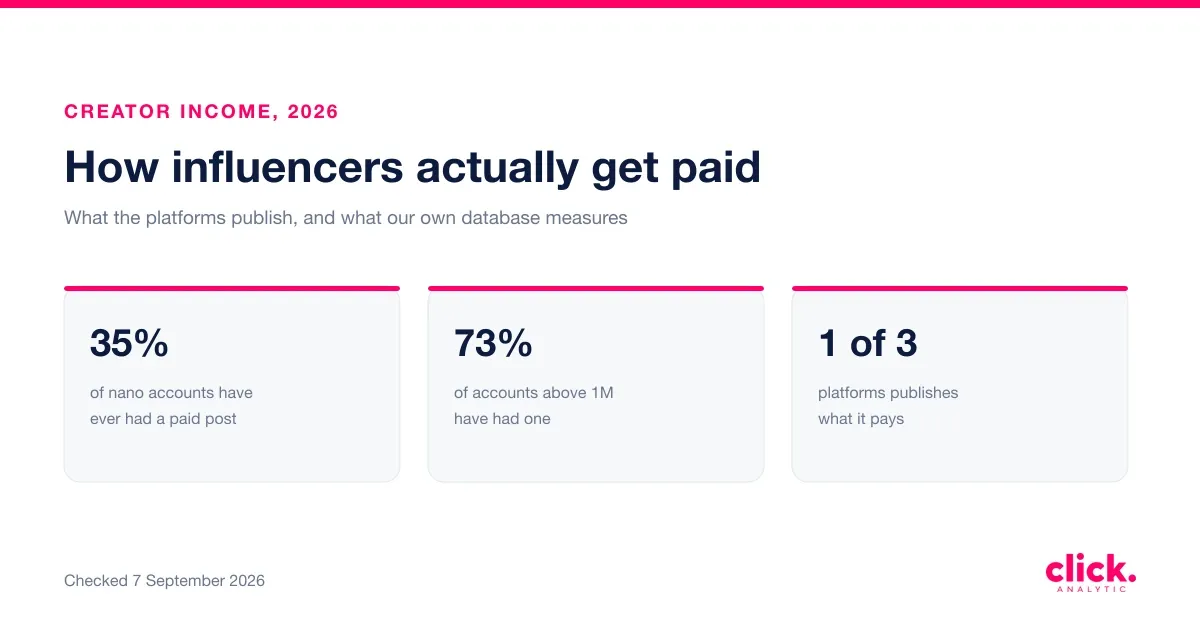
Every way influencers earn: each ad format on Instagram, TikTok and YouTube, each deal structure, what the platforms publish, and our count of how many creators have ever had a paid post.
Influencer Media Kit: What to Include & How to Make One (2026)
Think of your media kit as a one-stop snapshot. It can be a short PDF or a simple web page that shows your audience, performance, creative strengths, offers, pricing, case studies, and contact details.