How TikTok Shop Works: Every Role, Every Step of the Sale
By Denis GolubevMarketing tips
Quick answer
TikTok Shop is TikTok's in-app marketplace. Sellers list products, creators promote them in shoppable videos, LIVE streams and profile Showcases, and shoppers buy without leaving the app. TikTok handles checkout and payment, the seller ships the order and manages returns, and TikTok charges a referral fee on the sale. When an affiliate creator drove the order, the seller also pays that creator a commission once the order settles. Availability, fees and eligibility rules are set market by market, so the exact flow depends on where the shop and the shopper are.
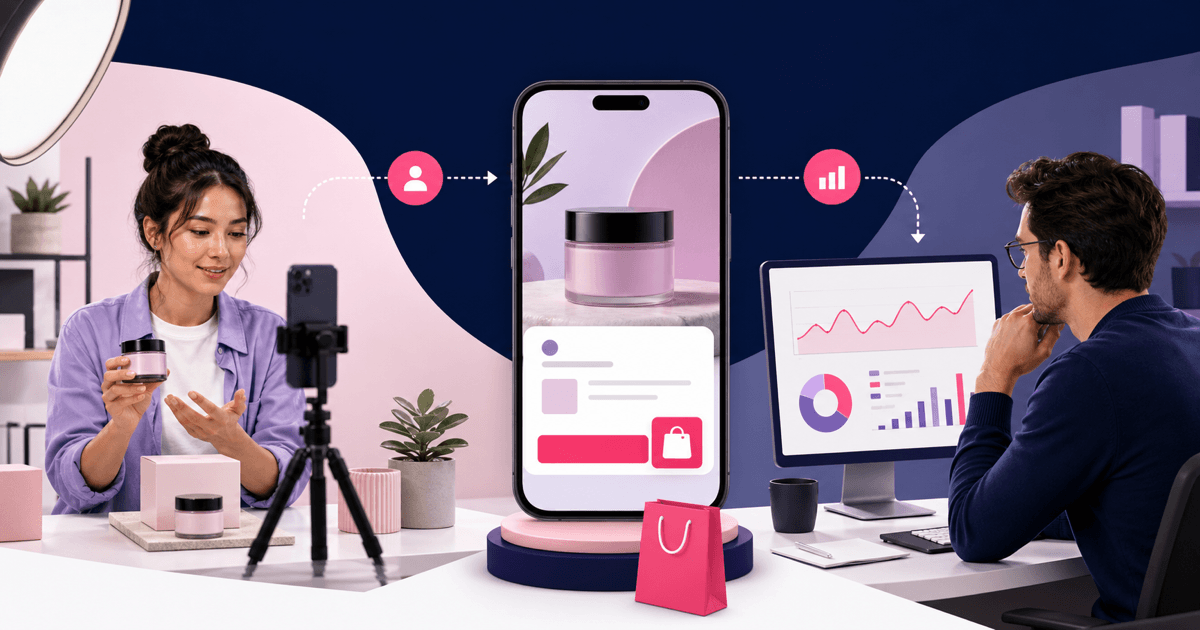
One TikTok Shop order passes through five roles before anyone is paid.
What is TikTok Shop?
TikTok Shop is the commerce layer built into TikTok. Sellers list products, creators recommend them in shoppable content, and shoppers pay inside the app instead of being sent to an external website.
TikTok describes the same surfaces in its own announcements: products tagged in videos and LIVEs in the For You feed, LIVE sessions used for demonstrations, a profile Showcase with product tiles and reviews, and an affiliate network where approved creators promote products and earn commission. That description comes from the European expansion announcement published on 28 May 2026.
It is not a separate app, and it is not an advertising product. A shopper never downloads anything new, and a seller does not buy media to appear in TikTok Shop. Paid promotion exists alongside it, but the shop itself is organic surface plus checkout.
The five roles, and who controls what
Five parties touch a TikTok Shop order. Most confusion about the platform comes from collapsing two of them, usually the brand and the seller, or the creator and the affiliate.
Role
Decides
Earns or pays
Shopper
What to buy, and whether to return it
Product price, shipping and tax at checkout
Seller
Listings, price, stock, fulfillment, returns, commission offered to creators
Keeps the order value after the platform fee, creator commission and fulfillment cost
Brand
The product, its claims and the creator brief
Sells through its own shop, or through a seller that stocks its products
Creator (affiliate)
Which eligible products to feature, and in what format
Commission on qualifying orders, released after settlement
TikTok
Discovery, checkout, payment, eligibility rules and fee policy
A referral fee on qualifying sales
Who does what in a TikTok Shop transaction
A brand is the company behind the product. A seller is the storefront that holds the listing and ships the order. They are often the same company, and often not, which is why a brand can be promoted by creators who never appear in that brand's own shop reporting.
What sellers and creators may not do
The roles come with limits, and the limits are set per market. In the United States, TikTok's prohibited products policy bars whole categories outright, from weapons and drugs to monetary and financial products, and treats virtual or digital goods as prohibited unless they are approved under its Virtual Goods category. Its product listing policy requires listings to be clear and truthful, bans deceptive or misleading presentation, and specifically prohibits describing a product as a dupe, fake or knock-off. Creators carry a rule of their own: TikTok's guidance on redirecting traffic prohibits pushing viewers to DMs, external links, other websites, socials or QR codes to buy a promoted product. Each of those lists is market-specific and gets revised, so read the current version in Seller Center.
How a TikTok Shop sale actually happens
One order moves through eight steps, and money changes hands at three of them.
A shopper meets a product attached to a video, a LIVE stream, a product card or a profile Showcase.
Tapping the product opens its page inside TikTok, with price, variants, reviews and delivery terms.
The shopper checks out in the app. TikTok collects the payment, and the session never leaves TikTok.
The order appears in the seller's Seller Center and is routed to whichever fulfillment method the seller uses.
The seller ships inside the handling window for that market, and tracking is attached to the order.
The order is delivered, and the market's return window opens.
TikTok applies its referral fee. If an affiliate creator drove the order, commission is calculated on the qualifying amount.
Once the return window closes and refunds are resolved, the order settles, and the seller payout and the creator commission are released.
The gap between step three and step eight is where most misreadings start. An order counted at checkout is not money in a bank account. Cancellations, partial refunds, full returns and disputes all reduce what the seller keeps and what the creator is paid.
Shoppable video
A creator or seller attaches an eligible product to a normal short video. The product sits on the video as a tappable card, so the buying decision happens in the same scroll as the discovery. This is the surface with the widest reach and the shortest attention window.
LIVE shopping
In a LIVE session the host demonstrates products, answers questions in real time and pins items as they go. TikTok reports LIVE separately for sellers, with per-stream measures such as GMV, GPM and click-to-order rate documented in its LIVE metrics guide, which is a signal that LIVE performance should be judged on its own terms rather than blended into a creator's video numbers.
Product cards and the profile Showcase
Product cards sit in the Shop tab and in search results, where intent is already commercial. The Showcase is the product shelf on a creator or seller profile, and it keeps selling after a video stops circulating. Neither depends on new content being published that day.
These are three different jobs, and TikTok treats them that way in its own reporting: the Shop Analytics documentation splits revenue into LIVE GMV, Video GMV and Product Card GMV. A creator who is strong on one surface is not automatically strong on another.
Why a product shows up in a feed
TikTok does not publish how it ranks products, and anyone who states the weighting is guessing. What can be observed from outside is which inputs are in play, not how they are scored.
The video has to earn distribution the way any TikTok video does, through watch time, replays, comments and shares. The product has to be eligible: listed, in stock and clear of the prohibited and restricted product rules for that market. And the surface carries its own intent, because a product card in the Shop tab or in search meets someone who is already shopping, while the same product attached to a video in the For You feed meets someone who was not. Treat those as inputs rather than a formula. TikTok has never disclosed how they are weighted against one another, and no third party can measure that from outside.
Who gets paid, and in what order
The shopper pays once. That single payment is then split, and the split does not resolve on the day of the order.
Line
Goes to
When
Product price, shipping and tax
Collected by TikTok
At checkout
Referral fee
TikTok
Deducted from the order
Affiliate commission
The creator
After the order settles
Remaining order value
The seller
At payout, once the return window has closed
Refunds and cancellations
Back to the shopper
Reduce every line above
How one TikTok Shop order is divided
None of these lines is GMV. TikTok's own Shop Analytics documentation, updated on 12 November 2025, calculates GMV as product list price multiplied by items sold, plus shipping fee, minus discounts and tax, and states that the figure includes cancelled and refunded orders. If you want the metric taken apart properly, read what GMV means on TikTok Shop.
Fee levels are set per market. As a dated example, TikTok's United States referral fee schedule, effective 31 October 2024 and last updated on 14 May 2026, applies 6% to most categories, 5% to five jewelry subcategories, and a tiered rate to pre-owned goods and collectibles. Those are US rates. Do not carry them into a plan for another market.
Creator commission is separate from the platform fee and is set by the seller on the product or the collaboration. TikTok's affiliate orders documentation explains how qualifying revenue, refunds and settlement affect the final amount. A listed commission rate is an offer, not a payout.
Where TikTok Shop is available
TikTok Shop opens market by market rather than globally. In Europe it is live in Austria, Belgium, France, Germany, Ireland, Italy, the Netherlands, Poland, Spain and the United Kingdom, after TikTok announced on 28 May 2026 that the four newest markets would open on 15 June 2026. The same announcement cites 200 million monthly European users and more than 100,000 European sellers.
Outside Europe, TikTok Shop operates in the United States, Mexico, Brazil, Japan and across Southeast Asia, including Indonesia, Malaysia, the Philippines, Singapore, Thailand and Vietnam. The list moves, so confirm it in Seller Center before committing to a launch market.
What varies by market is not cosmetic: creator eligibility thresholds, referral fee schedules, sample rules, settlement timing and the available fulfillment methods all differ. TikTok also runs its own logistics option, Fulfilled by TikTok, alongside seller-managed shipping, and it changed its position on fulfillment requirements more than once during 2026. Read the current requirement in your own Seller Center rather than a blog, this one included.
TikTok and TikTok Shop are not the same job
Same app, two different scoreboards. On TikTok a creator is judged on reach, watch time and engagement. On TikTok Shop the same creator is also judged on what the audience actually buys, which is why a large following and a strong sales record are not the same evidence.
The two records do not travel together. Shop features are gated by market and account eligibility, so a strong TikTok creator can have no TikTok Shop history at all, and a creator with visible Shop activity can still be wrong for your product or your market. A product in a video or a Showcase is not proof of a paid partnership. Treat it as observed activity until the relationship is confirmed.
In practice that means reading two layers of evidence on every candidate. The audience layer covers followers, growth, views, engagement quality and audience fit. The commerce layer covers products and shops featured, shoppable video and LIVE cadence, and estimated GMV and units sold with the period and currency stated. Neither layer is enough alone, and estimated GMV is not a quality score. For the full selection process, read how to find TikTok Shop influencers.
The shopper's side: payment, delivery and returns
The eight steps above describe the sale. The shopper's half of it is simpler, and worth stating plainly because it decides who fixes what. TikTok collects the payment, so the money never passes through the seller's own checkout, and a refund therefore runs back through TikTok's order flow rather than a seller's website. Cancelling, returning and disputing all happen in the app, in the shopper's own order list.
The rules are set per market. In the United States, TikTok's cancellation, return and refund policy gives a shopper the return window stated at checkout, or a default of 30 calendar days from the date the package is marked delivered, and qualifying sellers can set that window to 14, 30, 45 or 90 days depending on the category. Past it, a Money-Back Guarantee claim can still be raised within 90 calendar days of receiving an order that arrived damaged, defective or not as described, with eligibility shown on the product page.
What TikTok does not do is touch the goods. The seller ships the order and handles what comes back. Those are US rules, and other markets publish their own.
Where Click Analytic fits
Click Analytic sits before the invitation, not inside the shop. It is a research layer for deciding which creators, brands and products are worth approaching.
Open a comparable brand or product category and review the creators with recent covered activity behind it.
Compare estimated GMV and units sold within the same market, period and currency, and read shoppable video separately from LIVE.
Check audience age, gender and engagement quality, then shortlist and move to outreach.
The limits matter as much as the capability. Coverage runs to 15 TikTok Shop markets and depth varies between them, so a market outside that set is absent from the data rather than empty. Click Analytic commerce figures are modelled estimates, not official TikTok data or settled revenue. Attribution of your own TikTok Shop orders is TikTok's job and shows up in your own seller reporting; Click Analytic sits before that, on the research side, and does not create shops, enroll creators, set or pay commission or measure campaign ROI inside TikTok Shop.
Sources and verification
This explainer was reviewed in August 2026 against TikTok's Shop Analytics documentation, its United States referral fee schedule, its LIVE metrics guide, its Fulfilled by TikTok guide, its return and refund policy, its prohibited products and product listing policies, its traffic redirection policy, its Affiliate program pages and its May 2026 European expansion announcement. Market availability, fees, eligibility and settlement rules change, and they change per market.
Click Analytic product descriptions were checked against the capabilities available in August 2026. TikTok Shop remains the only source for your own account eligibility, order status, fee treatment and settlement.
TikTok Shop is the shopping layer inside TikTok. Sellers list products, creators promote them in videos, LIVE streams and profile Showcases, and shoppers buy without leaving the app. TikTok handles discovery, checkout and payment, and charges the seller a referral fee on qualifying sales.
No. TikTok is the content platform and TikTok Shop is the commerce layer inside it. A creator can be successful on TikTok without ever selling, and a creator with a modest following can sell well. Reach and sales are two separate pieces of evidence about the same account.
Mainly through a referral fee charged to the seller on qualifying sales. In the United States, TikTok applies 6% to most categories, 5% to five jewelry subcategories and a tiered rate to pre-owned goods and collectibles, under a schedule effective 31 October 2024 and last updated on 14 May 2026. Other markets publish their own rates.
The seller is responsible for fulfillment. Depending on the market, that can mean shipping directly, using a third-party logistics provider, or using TikTok's own Fulfilled by TikTok service, which stores, picks, packs and ships on the seller's behalf. TikTok changed its position on fulfillment requirements during 2026, so check the current requirement in Seller Center.
No. Commission follows settlement, not checkout. Delivery, the return window, refunds, cancellations, disputes and product eligibility can all change the final amount, so an order shown on the day it is placed is an estimate of earnings rather than a payment.
There are real buyer protections, and they are not a guarantee of product quality. Payment goes to TikTok rather than to the seller, so cancellations, refunds and disputes run through TikTok's own order flow rather than a merchant's website. In the United States a shopper gets the return window shown at checkout, or a default of 30 calendar days from delivery, plus a Money-Back Guarantee window of 90 calendar days for an order that arrived damaged, defective or not as described. What those rules do not cover is how good the product is. Listings come from independent sellers whose quality and service vary, so read the reviews on the listing itself. Protections and windows also differ by market.
There is no single answer, because delivery depends on the market, the seller and the fulfillment route. A seller may ship an order themselves, use a logistics provider TikTok lists, or use Fulfilled by TikTok, and each behaves differently. Sellers are held to handling and dispatch windows that TikTok sets per market, and orders that miss them count against the seller's own performance metrics. The estimated delivery date shown on the listing before you check out is the figure to go by, not a platform-wide average.
In the United States, mostly no. TikTok's prohibited products policy states that virtual or digital products are prohibited unless they are approved for sale under its Virtual Goods category, while physical products that carry digital content, such as DVDs, are permitted. Physical goods are the core of the marketplace. Other markets publish their own prohibited and restricted lists and those lists change, so confirm the current rule for your market in Seller Center before building a listing around it.
Try our Influencer Marketing Platform for free
Find Influencer email addresses and Contact Influencers with ClickAnalytic Influencer marketing software.
Actionable tips to get more success with influencer marketing campaigns.
TikTok vs TikTok Shop: What Is the Difference?
TikTok is built around content discovery. TikTok Shop adds products, shoppable content, checkout and affiliate commerce where those features are available.
How the TikTok Shop Affiliate Program Works for Creators and Sellers
A practical guide to TikTok Shop Affiliate for creators and sellers, from eligibility, samples and commission to choosing creators with relevant commerce history.
How to Find TikTok Shop Influencers for Your Brand
Find TikTok Shop creators who fit your product, market and buyer. Use commerce activity, audience quality and a repeatable scorecard to build a shortlist your team can defend.