Social media KPIs directly impact revenue, customer acquisition, and long-term brand growth.
For example, a post can reach 500,000 views and drive zero sales, so numbers rise, but results do not.
This happens because KPIs are treated as universal truths instead of signals tied to a specific goal.
According to a study, 31% of marketers reported using data to demonstrate ROI, while 35% use data to inform their strategy, highlighting the growing need to connect social metrics with real performance outcomes.
But the real critical question is: which social media KPIs actually impact your business?
Tracking likes, impressions, and follower growth may inflate dashboards, yet these numbers rarely translate into conversions or revenue without the right framework.
In 2026, rising ad costs and algorithm shifts make it essential to measure KPIs that tie social media activity to measurable business results.
This guide breaks down 60+ essential social media KPIs, grouped by goal and funnel stage.
You’ll learn which metrics matter, how to calculate them, and how to build a reporting structure that aligns social media performance with real business impact.
Here’s what you’ll learn:
✅ 60+ social media KPIs explained with context
✅ Platform-specific social media KPIs
✅ Creator and influencer marketing KPIs
✅ What are “Audience Overlap” KPIs
✅ How to automated creator tracking and attribution
By the end, you won’t track more social media KPIs. Instead, you’ll track the ones that drive decisions.
About the Author
Paul Boulet is the Founder of Click Analytic, an influencer marketing and creator analytics platform used by brands and agencies to measure campaign performance and ROI across Instagram, TikTok, and YouTube.
He has spoken at several universities and industry events about the power of social media and the growing impact of influencers on brand growth.
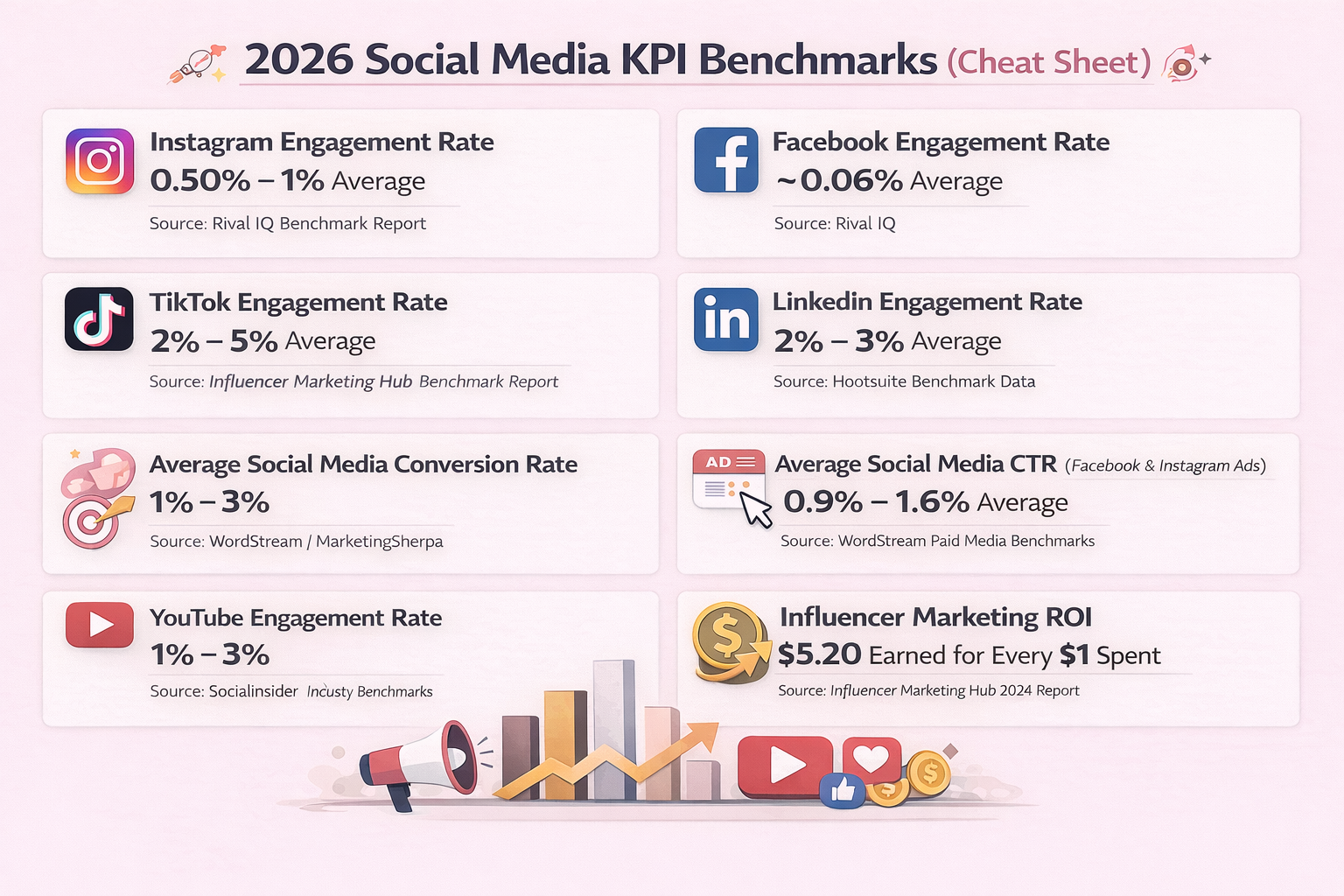
2026 Benchmarks Snapshot
To evaluate social media KPIs meaningfully, you need benchmarks, not just definitions.
A metric alone means nothing without comparison. Benchmarks give your data context and show whether your performance is above, below, or aligned with industry standards.
These figures reflect recent cross-platform industry data and will help you set realistic targets for your key social media KPIs in 2026:
How to Use These Benchmarks
- Set expectations by platform: Use platform-specific norms instead of applying a single “good” number everywhere.
- Compare by content type: Video content (Reels, TikTok) typically sees much higher engagement than static content.
- Track trends over time: Benchmarks change; measure your performance against these norms quarterly or annually.
These benchmarks help you move from generic metric tracking to goal-driven KPI performance measurement, so you can judge whether your results are truly strong or simply average.
Let’s go into the theory of Social Media KPIs before diving into each KPIs 👇
What Does KPI Stand for?
Before we identify the right Social Media KPIs for your business, we must first define KPIs.
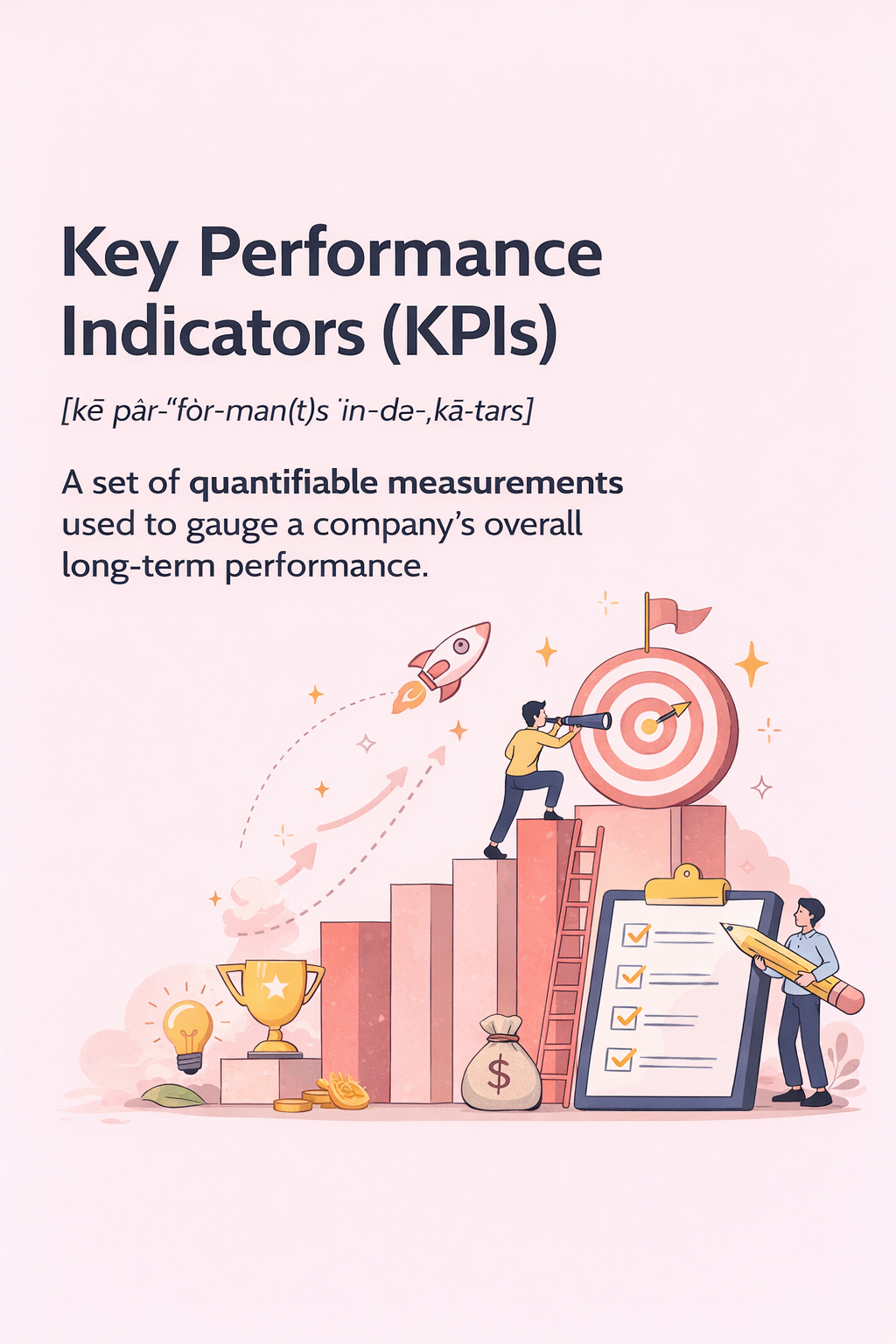
💡KPI stands for Key Performance Indicator. KPIs measure how effectively a business achieves a specific marketing or social media goal.
Now, let’s look at what Social media KPIs are!
What Are Social Media KPIs?
💡Social media KPIs aren’t just numbers you report. They’re measurable indicators used to evaluate whether a social media campaign is achieving a specific marketing goal.
For example, if your Instagram post generated 10,000 views, that number becomes a meaningful social media KPI when your objective is brand awareness.
If your goal is conversions, however, views alone are not enough ❌
You would need to track click-through rate, conversion rate, or revenue generated.
In other words, social media KPIs connect platform activity to various outcomes like awareness, engagement, traffic, conversions, or retention. They show you what to change, what to scale, and what to stop.
But what is a KPI vs. a simple metric??
KPI vs Metric
👉A metric is any measurable data point.
👉A KPI is a metric chosen because it reflects progress toward a goal.
Views, likes, impressions, clicks, and followers are all metrics. They become social media KPIs only when they’re tied to a defined objective.
For example, video views can be a social media KPI for awareness. The same views mean nothing for a conversion campaign if they don’t lead to action.
The mistake most teams make is assuming every metric deserves equal attention.
It does not.
Many marketers now view vanity metrics such as followers and likes as their key social media KPIs.
But here’s the difference between a KPI and vanity metrics 👇
KPI vs Vanity Metric
A vanity metric looks impressive but does not inform a decision.
High follower growth feels good. Viral reach screenshots look convincing.
None of that matters if the audience never clicks, converts, or returns…
Social media KPIs force accountability. Vanity metrics create comfort.
💡Remember this: If a number cannot influence your next decision, it should not be a KPI.
Speaking of vanity metrics within social media KPIs, let’s look at Follower Count 👇
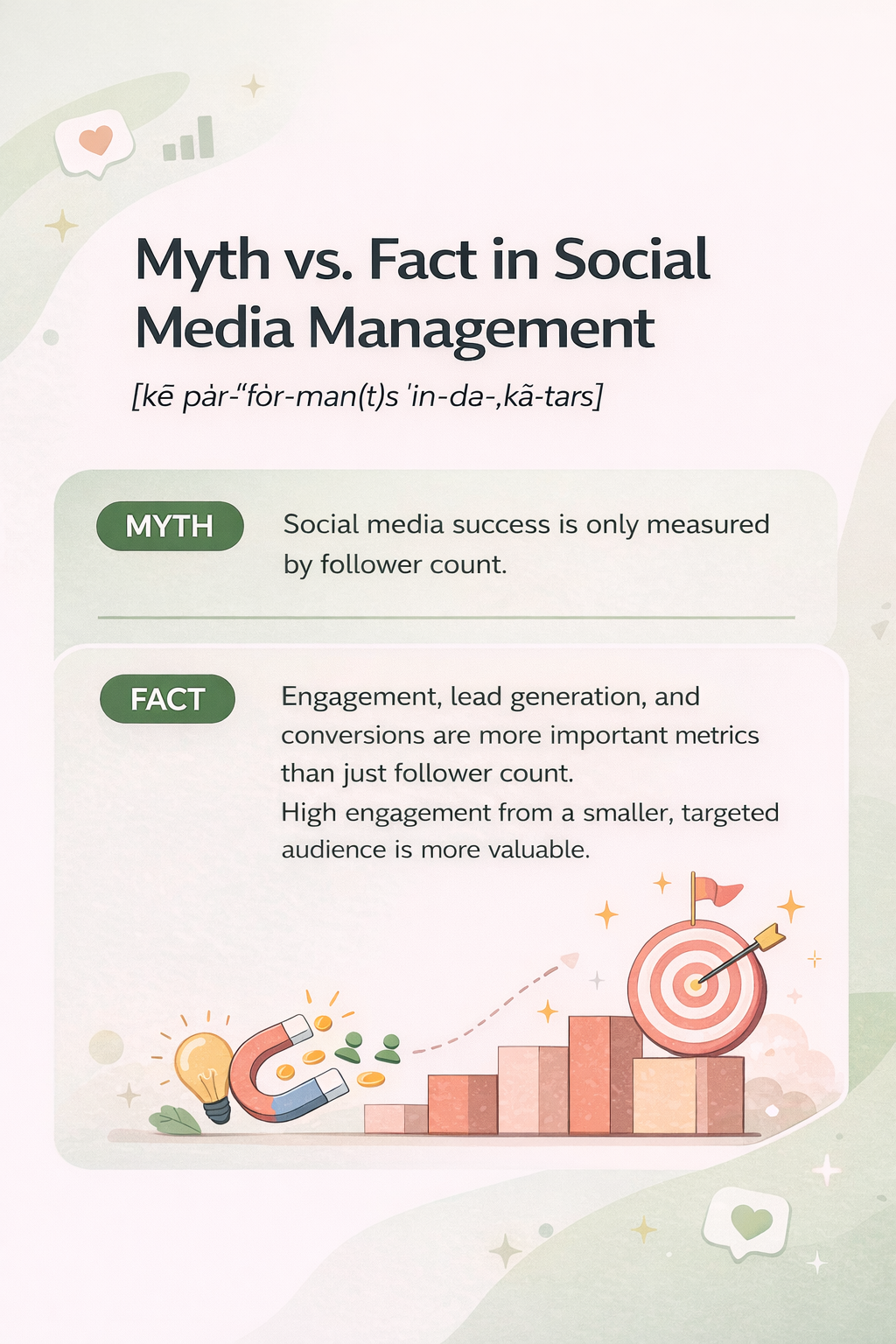
Why Follower Count Alone is Misleading
Follower count is one of the most misunderstood social media metrics.
It does not tell you:
❌Who sees your content
❌ How often they engage
❌ Whether they trust your brand
❌ If they’re likely to buy
In 2026, distribution depends on content performance, not audience size. Accounts with smaller followings often outperform larger ones because relevance and retention matter more than scale. Follower count can help track awareness, but it tells little by itself.
For instance, Adidas’ partnership with Molly Mae worked not because of follower count alone. Her audience already engaged with and wore Adidas organically.
This gave the brand real reach beyond recycled followers.
A Quick Example of Why KPIs Matter More Than Metrics Alone
A brand launched a creator campaign to drive signups. They tracked follower growth, likes, and comments. On paper, it looked successful. But when they switched the KPI to cost per signup, performance dropped.
Most engagement came from users outside the target market. The campaign did not fail. The KPI was wrong. Social media KPIs only work when chosen after defining the goal.
The next section is going to show you how to define your marketing goal before selecting social media KPIs.
How to Define Your Marketing Goal Before Choosing Social Media KPIs
Social media KPIs only work when chosen after the goal is clear.
👉 Most teams do it backward: they open analytics, pick available metrics, and try to force meaning. That produces reports, not clarity.
A marketing goal answers one question: what should change if this campaign succeeds? Without that, no KPI is reliable.
Almost every campaign fits into five core outcomes. Each requires a primary KPI, a few supporting metrics, and limits on what not to track. Most frameworks fail because they list metrics without explaining when they truly matter.
5 Core Social Media Marketing Goals
Here’s a breakdown of key social media marketing goals:
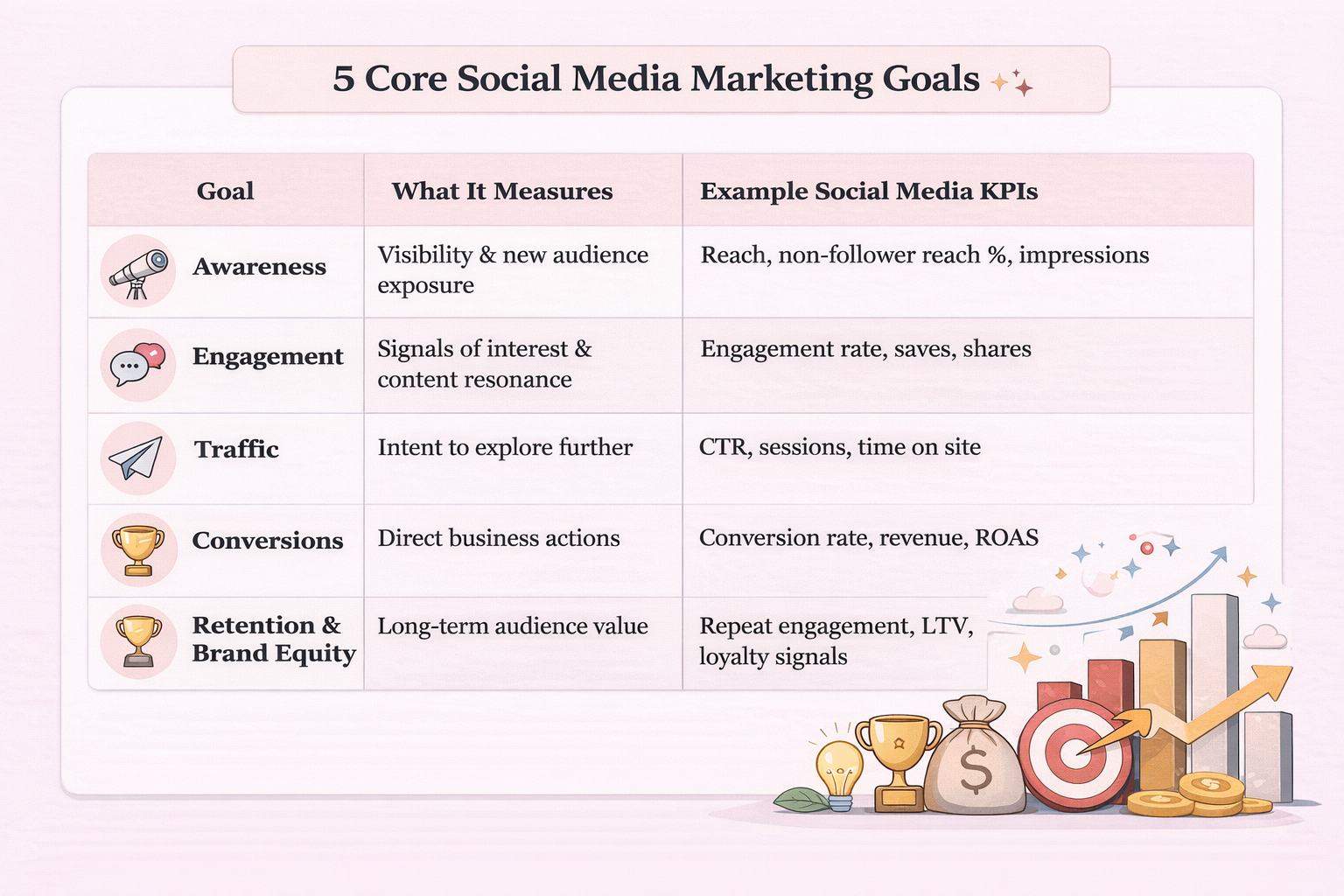
Understanding the social media marketing goals is only the beginning.
Next, we’ll look at how the right social media KPIs align with each goal and prevent teams from tracking irrelevant metrics.
KPI Mapping by Goal
Each marketing goal should have one primary KPI that defines success. Supporting KPIs explain why performance changed, while everything else creates noise.
| Marketing Goal | Primary KPI (Defines Success) | Supporting KPIs (Explain Performance) | What NOT to Track |
| Awareness | Reach or impressions among the target audience |
|
|
| Engagement | Engagement rate |
|
|
| Traffic | Click-through rate (CTR) or sessions |
|
|
| Conversions | Cost per conversion |
|
|
| Retention & Brand Equity | Repeat engagement or repeat exposure |
|
|
Social Media KPIs by Funnel Stage
Social media KPIs work best as part of a journey, not a checklist. This funnel shows how attention turns into action and which metrics truly matter at each stage.
1. Awareness – Are the right people seeing your content?
🎯 Key Metrics: Reach → Impressions → Video Views → View Rate
❌ Common Mistakes: Judging success by clicks or conversions too early
⬇️
2. Engagement – Does your content resonate?
🎯Key Metrics: Engagement Rate → Saves → Shares → Comments → Watch Time
❌ Common Mistakes: Optimizing for total volume instead of quality
⬇️
3. Traffic – Are people taking the next step?
🎯 Key Metrics: CTR → Link Clicks → Sessions → Landing Page Views
❌ Common Mistakes: Tracking clicks without considering post-click behavior
⬇️
4. Conversions – Did social drive action that matters?
🎯 Key Metrics: Conversions → Conversion Rate → Cost per Conversion → ROAS
❌ Common Mistakes: Ignoring attribution windows or assisted conversions
⬇️
5. Retention & Loyalty – Do people come back?
🎯 Key Metrics: Repeat Engagement → Returning Audience → Repeat Purchases → Brand Mentions
❌ Common Mistakes: Focusing on one-off virality instead of consistent growth
In the next sections, we break down platform-specific and category-specific social media KPIs, moving down the funnel with context, examples, and common pitfalls.
How to Choose the Right Social Media KPIs
Not all Social Media KPIs serve the same purpose.
The metrics you track should align with where your audience sits in the customer journey.
This funnel framework organizes KPIs based on business impact — from visibility to revenue to long-term loyalty.
Use it as a strategic filter before diving into individual metrics.
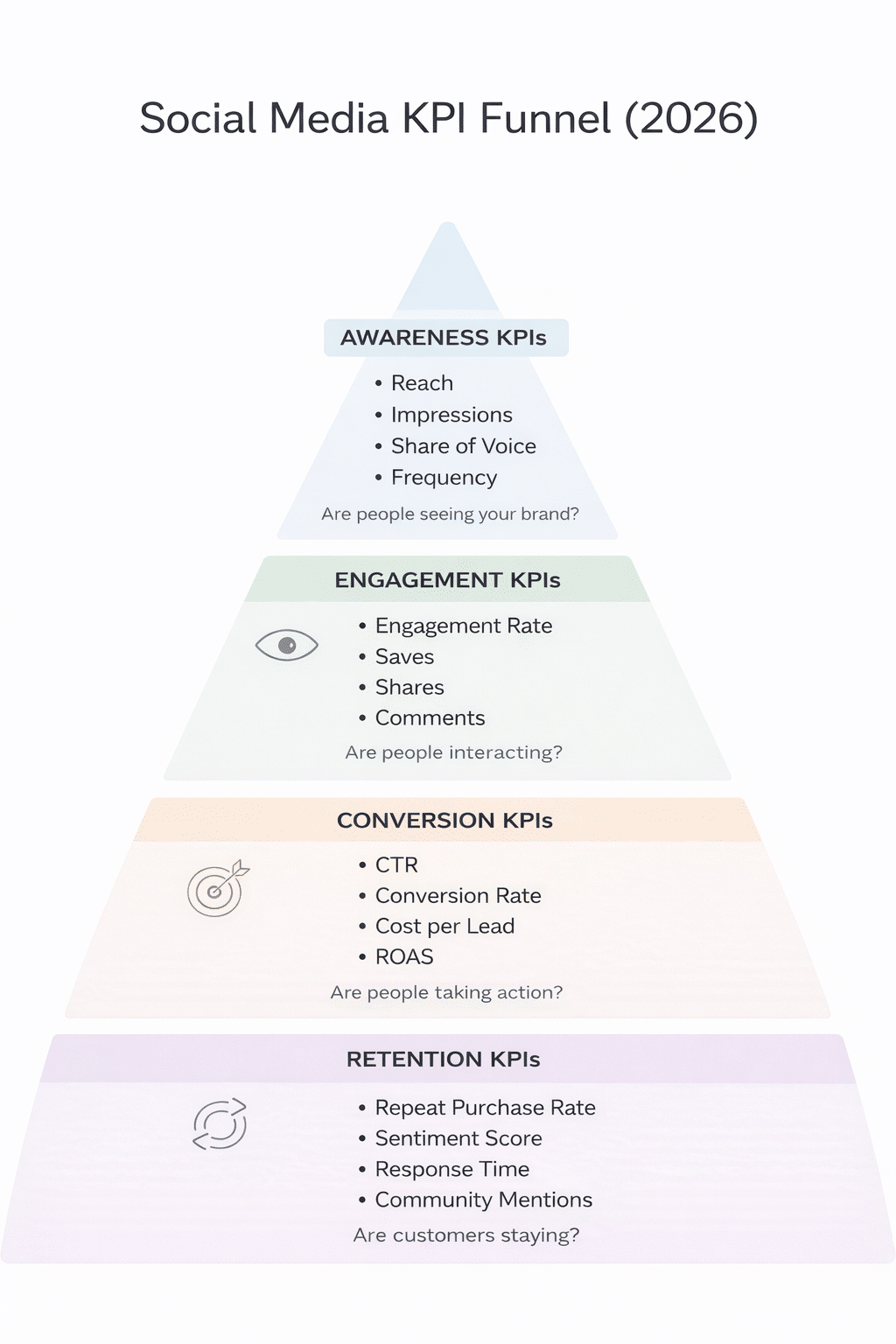
How to Use This KPI Funnel
Start at the top.
👉If your goal is brand visibility or awareness, focus on reach, impressions, and share of voice.
👉 If your goal is community building, prioritize engagement rate, saves, shares, and comments.
👉 If your objective is revenue, measure conversion rate, cost per lead, and ROAS.
And if you want sustainable growth, retention KPIs such as repeat purchase rate and sentiment score become critical.
Each layer builds on the previous one.
Strong awareness without engagement won’t convert.
Strong conversions without retention won’t scale.
That’s why Social Media KPIs must be selected strategically, not randomly.
Now let’s break down each KPI category in detail 👇
🟢 Reach & Distribution KPIs
Reach and distribution KPIs show how far your content spreads and how effectively it connects with the right audience. These metrics form the foundation for awareness, engagement, and conversion goals, reflecting early engagement patterns and platform trust.
1. Reach
Reach is the total number of unique users who saw your content, and it’s relevant because it shows whether your content is reaching the right audience. It also sets the stage for engagement and conversions, and you measure it by counting the distinct accounts that viewed a post or story.
However, be careful not to assume high reach equals success. Keep in mind that without relevance or retention, large numbers can be misleading.
2. Impressions
Impressions track the total times your content was displayed, including multiple views by the same user. They help you understand content exposure frequency and whether posts are getting enough visibility to drive results.
However, don’t confuse impressions with reach. High impressions can hide low unique engagement.
For example, to illustrate those two social media KPIs 👇
If your campaign reaches 200,000 unique users but generates 450,000 impressions, this indicates repeat exposure.
Frequency = 450,000 ÷ 200,000 = 2.25
A frequency between 1.5 and 3 is often considered effective for brand awareness before audience fatigue begins.
For a deeper breakdown, see our full comparison of the difference between reach and impressions.
3. Reach per Follower
Reach per follower measures the percentage of your followers who actually see your content. Strong reach among followers shows loyalty and helps the algorithm recognize content that resonates with your audience.
NOTE: Don’t overlook non-follower reach, which often signals growth opportunities.
4. Median Impressions per Post
Median impressions show the typical number of times a post is displayed, avoiding distortion from one-off viral hits. They reveal consistent visibility and algorithmic support over time. However, watch for averages, as they can be skewed by outliers.
5. Non-Follower Reach %
This measures the portion of your total reach coming from users who don’t follow you. In other words, it indicates your content is attracting new audiences and growing organically. Additionally, pay attention to non-follower performance, as ignoring it can hide discovery potential.
6. Discovery Rate
Discovery rate tracks the percentage of new users reached relative to your audience size. It shows content is reaching fresh eyes, increasing relevance, and avoiding echo-chamber effects. Still, remember that discovery is not the same as viral spikes. Incremental growth often matters more.
7. Algorithm Amplification Rate
Algorithm amplification rate measures how often content spreads beyond your initial audience through platform recommendations. Strong amplification signals content that resonates and is likely to continue earning visibility.
However, don’t assume all organic reach is “free” exposure. Platforms prioritize content based on engagement and trust.
INTERESTING: Identical content can get about 40% less engagement solely because of where it appears in a social feed, showing that algorithmic positioning drives attention as much as content quality.
8. Feed vs Recommendation Reach
This compares users who see content in their feed versus via algorithmic suggestions. Keep in mind that feed reach isn’t the whole story. Recommendations often drive new audience growth.
9. Profile Visits
Profile visits count the number of users who visit your profile after seeing content. However, don’t mistake visits for conversions because they indicate interest, not direct action.
10. Distribution Velocity
Distribution velocity measures how quickly content spreads within the first hours or days of posting. Be mindful of waiting too long to judge performance. Early traction often predicts long-term results.
🟢 Attention & Retention KPIs
Attention and retention metrics show how long viewers actively engage with your content. While reach and impressions tell you who saw your posts, attention KPIs reveal whether people actually watched, stayed interested, and came back for more.
These metrics matter for short-form video platforms such as TikTok, Instagram Reels, and YouTube Shorts, where algorithms reward content that captures interest immediately and keeps viewers watching until the end.
1. Thumb-Stop Rate
Thumb-stop rate measures the percentage of users who pause scrolling and start watching your content. You can use it to see how effectively your content captures attention in the first couple of seconds.
Keep in mind that clicks or views alone do not indicate that users even stopped to watch.
2. Two-Second Retention
Two-second retention tracks the share of viewers who watch at least the first two seconds of a video. This metric is crucial for short-form campaigns where early attention determines algorithmic promotion.
Be aware that high view counts can hide early drop-offs.
💡Pro Tip: Early retention is one of the strongest indicators that viewers will continue watching and that content will reach more people through recommendations.
3. Three-Second Retention
Three-second retention shows how many viewers stay through the first three seconds. It helps benchmark whether your hook is effective across platforms. Do not treat all views as equal, because viewers dropping out early may indicate weak creative or misaligned targeting.
4. Five-Second Retention
Five-second retention measures how many viewers continue watching beyond the initial hook. It highlights whether your content maintains interest past the very beginning.
Avoid focusing only on the first two seconds without seeing if attention holds.
5. Average Watch Time
Average watch time calculates the mean duration viewers spend on your video by dividing total watch time by total views.
However, do not rely solely on total views, because a video with many views but a very short watch time is likely underperforming.
INTERESTING: A new metric called “Retentive Relevance” predicts whether users will return far better than clicks or likes, proving that deeper attention signals are stronger predictors of long-term engagement.
6. Watch Time as a Percentage of Video Length
This measures the portion of your video each viewer watches, letting you compare the content of different lengths. Avoid comparing raw watch time across short and long videos without accounting for length.
7. Completion Rate
Completion rate tracks the percentage of viewers who watch the video from start to finish. Remember that even short-form videos need a strong hook, pacing, and narrative to keep viewers until the end.
8. Quartile Retention
Quartile retention shows the share of viewers who reach 25, 50, 75, and 100 percent of your video. However, do not assume average watch time tells the whole story, because quartiles reveal where viewers drop off.
9. Rewatch Rate
Rewatch rate measures the percentage of viewers who watch the same video multiple times. Do not ignore this metric, because a single view does not capture true engagement or resonance.
Expert Tip: When viewers return to your content, it signals strong resonance. Platforms interpret repeated watches as high-value content, which increases reach and distribution.
🟢 Engagement KPIs That Actually Signal Interest
Engagement metrics measure how actively people interact with your content. Likes alone no longer tell the full story. Platforms favor posts that generate meaningful interactions such as shares, saves, and comments. These signals reveal audience intent, interest, and investment in your content.
1. Engagement Rate by Reach
Engagement rate by reach shows the percentage of users who interact with your content compared with how many actually saw it.
💡It’s calculated by dividing total engagements by total reach and multiplying by 100.
You can use this to see how compelling your content is to the people who encounter it. Watch out for focusing only on total engagement without considering the size of your audience.
🔖 You can use our free tool to calculate the engagement rate on any influencer or celebrity on TikTok.
2. Engagement Rate by Followers
This metric measures the percentage of your followers who engage with your content.
💡It’s calculated by dividing total engagements by total followers and multiplying by 100.
It helps evaluate how well your content connects with your existing community.
Let’s look at an example 👇
If an Instagram post receives:
- 5,000 likes
- 300 comments
- 200 shares
- 50 saves
That’s a total of 5,550 interactions.
If the account has 50,000 followers:
Engagement Rate = 5,550 ÷ 50,000 × 100 = 11.1%
For context, industry benchmarks suggest that Instagram engagement rates typically average between 1% and 3%, depending on audience size. (Source: Hootsuite Social Media Benchmarks Report)
🔖 You can use our free tool to calculate the engagement rate on any influencer or celebrity on Instagram.
However, do not confuse this with engagement rate by reach, as each metric offers different insight.
3. Likes
Likes are simple positive reactions to your content. They can indicate general approval and social validation. Keep in mind that likes alone are not the strongest signal of engagement.
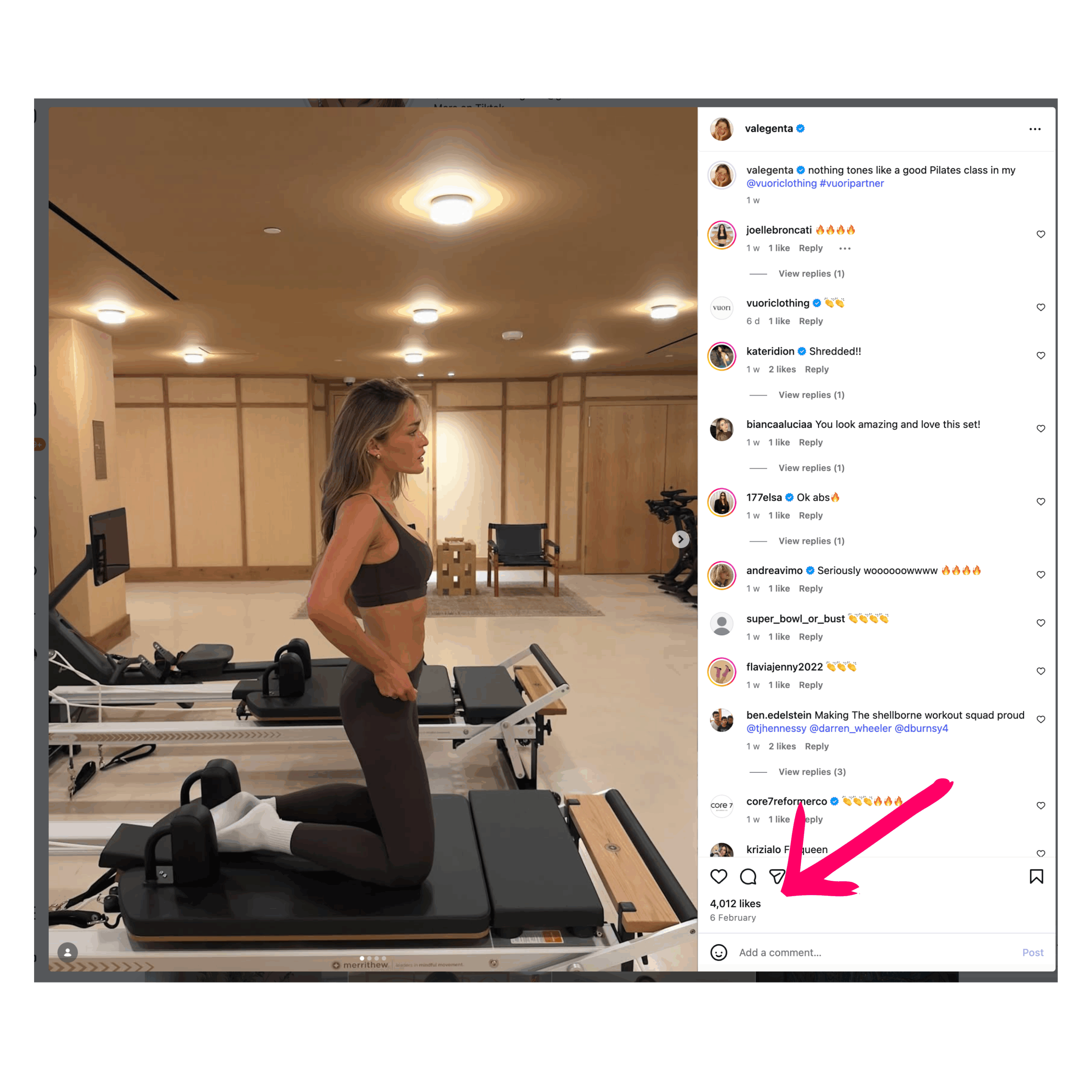
4. Comments
Comments track written responses to your content, giving insight into audience interest, sentiment, and conversation potential. Remember that not all comments are positive; some may be irrelevant or critical.

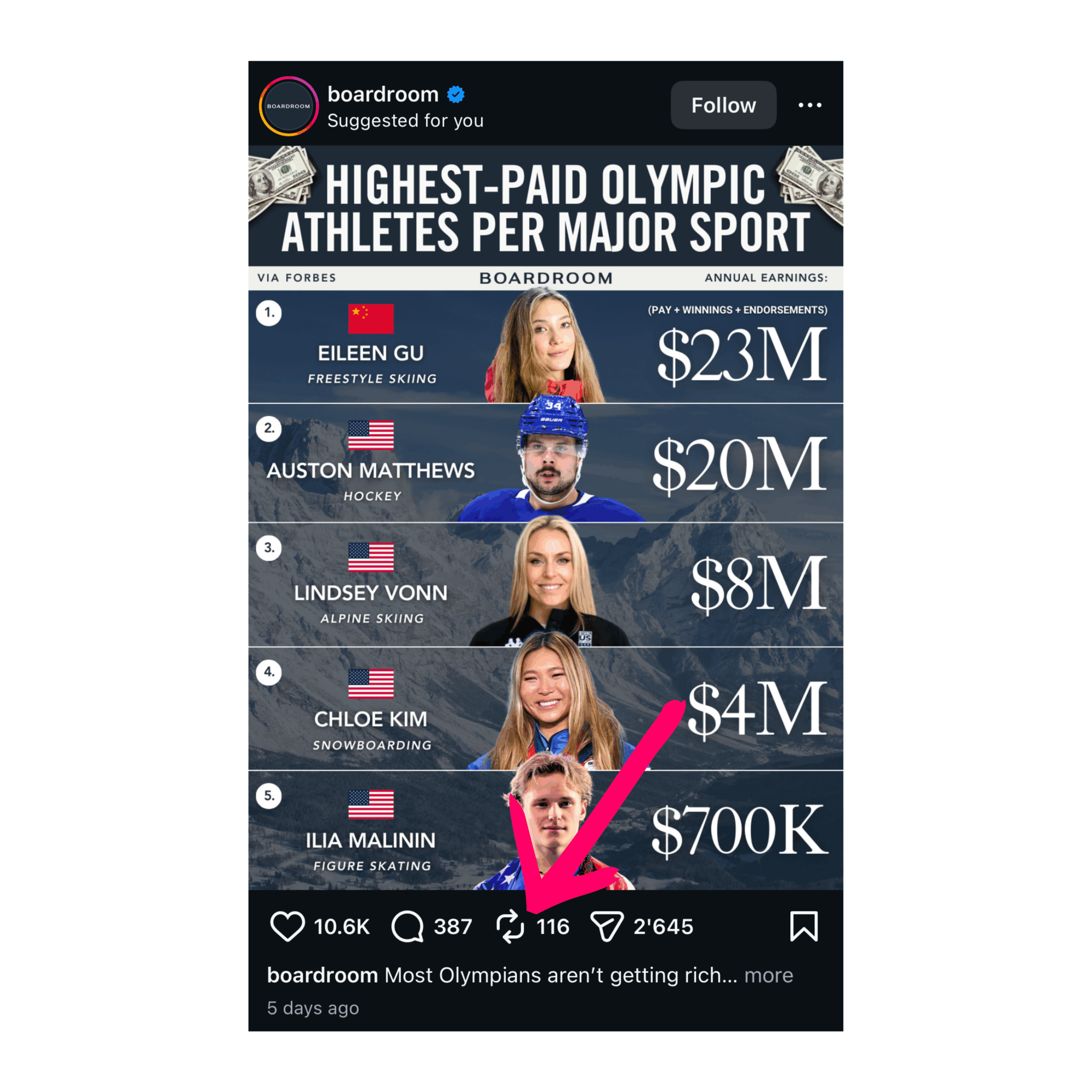
5. Shares
Shares indicate when users distribute your content to their own audience. You can use this to measure amplification and potential virality.
Be careful not to treat all shares equally because context and relevance matter.
6. Saves
Saves track when users bookmark content for later. This is especially useful for educational, inspirational, or reference-oriented content.
However, do not prioritize likes over saves if your goal is deep engagement.
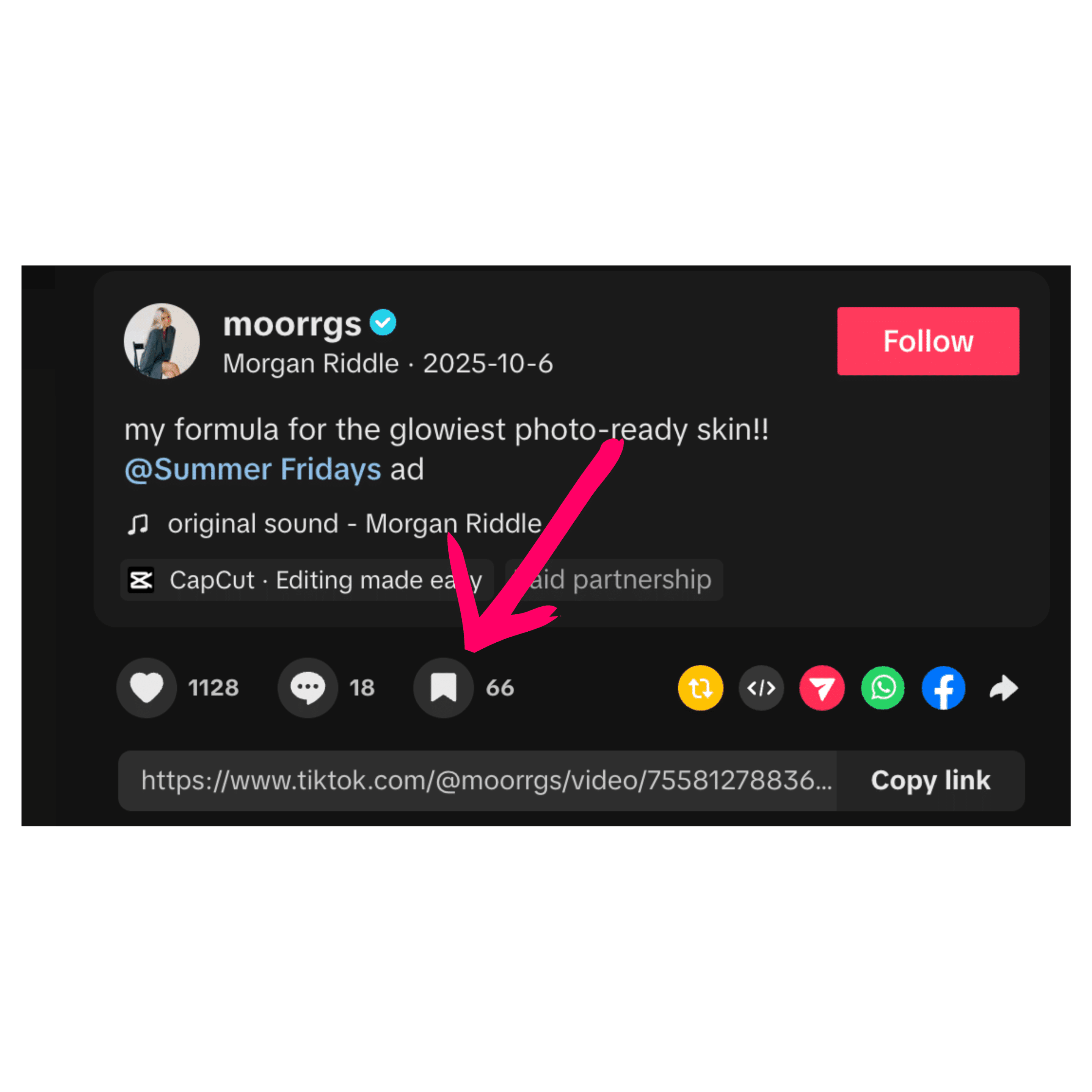
7. Save-to-Reach Ratio
This metric shows what percentage of viewers saved your content relative to total reach, calculated as saves divided by reach times 100. It helps benchmark performance across campaigns.
Avoid ignoring the audience size, because a large number of saves may seem impressive even if the reach was enormous.
8. Comment-to-Like Ratio
Comment-to-like ratio measures the depth of engagement relative to simple reactions, calculated as total comments divided by total likes. Do not assume that more likes always equal meaningful interaction.
Pro Tip: High ratios indicate content that sparks conversation rather than passive approval.
9. Share Rate
Share rate tracks the percentage of viewers who share content, calculated as shares divided by reach times 100. Watch out for audience overlap, as some shares only reach existing followers.
10. Engagement Velocity
Engagement velocity measures how quickly content accumulates interactions after posting. It’s a key signal of early performance. Avoid looking only at cumulative totals days later, because early activity predicts long-term distribution.
🟢 Community & Relationship KPIs
Community KPIs track ongoing interaction, trust, and loyalty. They reveal whether your brand fosters meaningful relationships and positions itself as mature and responsive.
1. Reply Rate
Reply rate measures the percentage of messages or comments that receive a response from your team. Use this to see how responsive your brand is to audience interactions. Keep in mind that ignoring replies can reduce trust and engagement.
Pro Tip: Platforms favor accounts that drive authentic interactions, and responsive brands retain attention and loyalty.
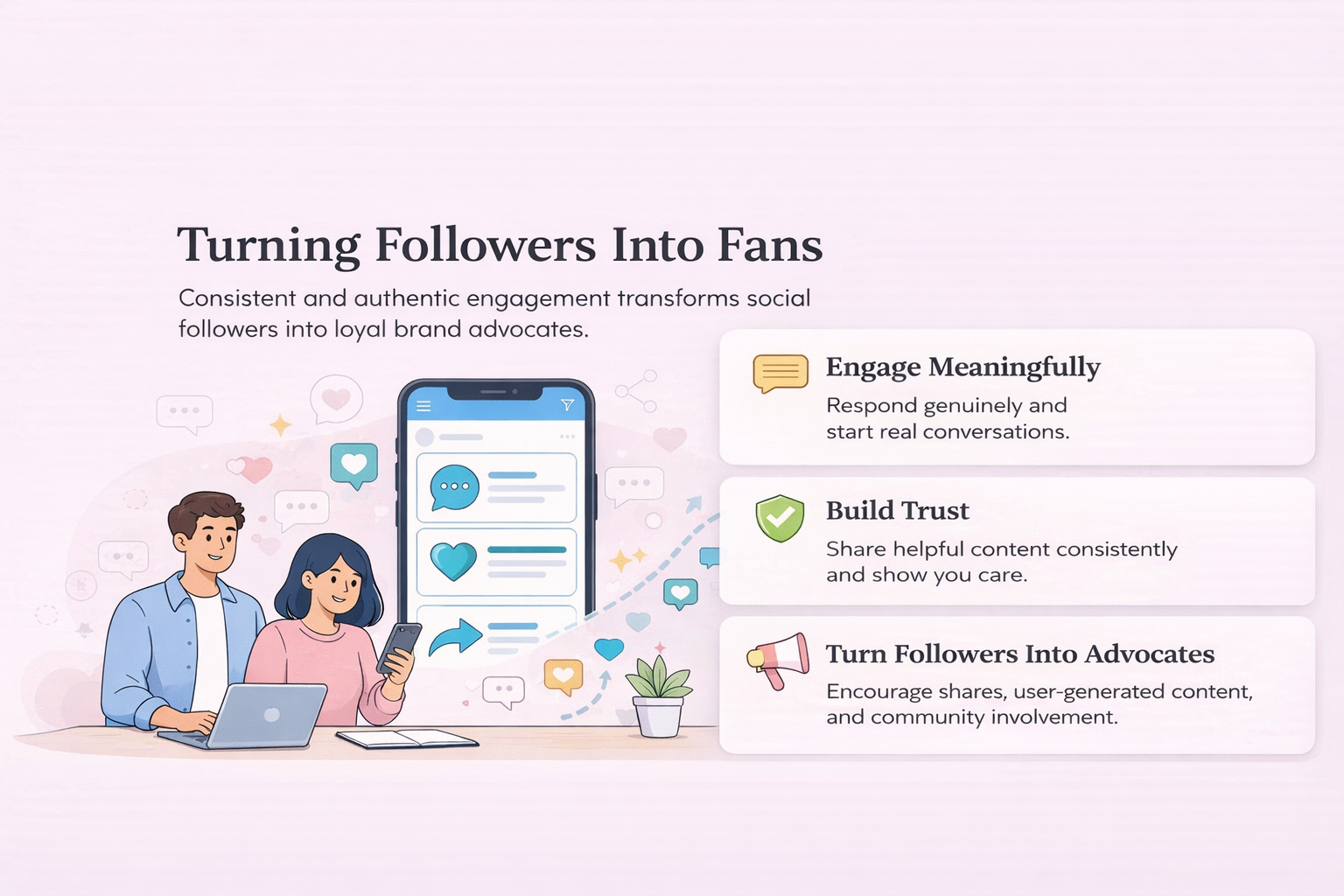
2. Conversation Depth
Conversation depth tracks the average length of comment threads or DM exchanges. It helps evaluate the quality of dialogue with followers. Be careful not to count comments without considering how meaningful they are.
3. DM Interaction Rate
DM interaction rate shows the percentage of direct messages that are responded to or acted on. This is key for brands providing support, consultations, or product guidance. Watch for neglecting DM performance as it’s a hidden driver of loyalty.
4. UGC Rate
User-generated content (UGC) rate measures the percentage of content created by users that references your brand. It reflects advocacy and community participation. Avoid counting branded hashtags without context, as that can misrepresent engagement.
5. Brand Mention Frequency
Brand mention frequency tracks how often your brand is mentioned across social platforms. It can indicate awareness, sentiment, and conversation trends. Don’t focus only on positive mentions because every mention provides insight.
6. Repeat Engager Rate
Repeat engager rate measures the percentage of users who interact with your content multiple times. It helps identify ongoing interest and loyalty. Avoid tracking only single interactions, which can understate community health.
7. Follower Interaction Frequency
Follower interaction frequency monitors how often your followers engage over a set period. It gives insight into long-term relationship health. Be mindful of focusing only on total engagements, as frequency shows sustainable interest.
🟢 Traffic & Click KPIs
Traffic KPIs show how effectively your social content drives audiences to your website or other owned properties. Raw clicks alone don’t tell the full story. You also need to understand the quality and intent behind the traffic to evaluate real impact.
1. Link Clicks
Link clicks measure the number of times someone clicks a link in your post. This helps you see whether your content motivates people to take the next step. Keep in mind that clicks alone don’t guarantee meaningful engagement.
Insider Tip: Context is key. Clicks show interest, but without quality traffic or follow-through, they don’t translate into business results.
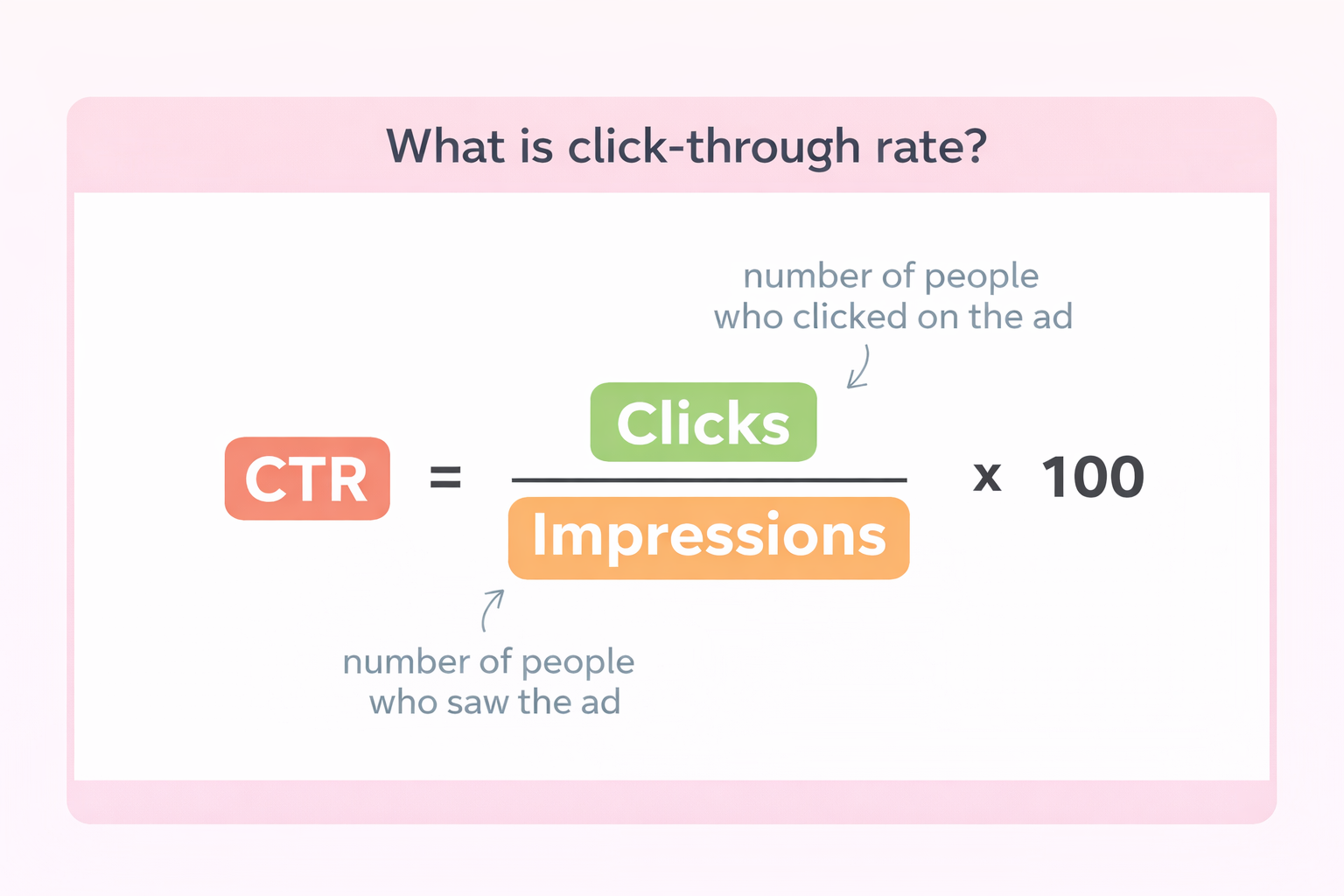
2. Click-Through Rate (CTR)
CTR tracks the percentage of people who click a link after seeing your content, calculated as (Link clicks ÷ Impressions) × 100. Use this to compare how effectively content converts exposure into action.
However, be careful not to rely on CTR alone, as high rates can come from low-intent users.
3. View-to-Click Rate
View-to-click rate is the ratio of content viewers who click through, calculated as (Link clicks ÷ Views) × 100. This is especially useful for videos or visual campaigns.
NOTE: Don’t overlook this metric, because CTR alone can hide weak engagement.
4. Sessions from Social
Sessions from social count the number of website visits coming from your social channels. Avoid assuming all sessions are valuable because some traffic may be fleeting or irrelevant.
5. Bounce Rate from Social
Bounce rate tracks the percentage of social-driven visitors who leave without interacting. Watch for ignoring bounce rate, since clicks alone can give a false sense of success.
💡Expert Tip: High bounce suggests your audience isn’t finding what they expected, highlighting landing pages or targeting issues.
6. Time on Site
Time on site measures the average duration of visits from social content. Be mindful that short visits may not reflect real engagement.
7. Assisted Traffic
Assisted traffic tracks visitors influenced by social content who ultimately convert through another channel. Don’t ignore this metric, as it highlights the indirect value of social campaigns.
8. Traffic Quality Score
Traffic quality score combines engagement, conversions, and visitor behavior to show whether social-driven traffic is relevant and actionable. Avoid using raw clicks or session numbers as the only measure.
🟢 Conversion & Revenue KPIs
Conversion and revenue KPIs connect social activity to real business outcomes, such as purchases, leads, or customer lifetime value. These metrics reveal whether your campaigns actually drive measurable impact, which is especially critical for paid campaigns, performance creators, and ROI-focused strategies.
1. Conversions
Conversions measure the total number of desired actions completed, like signups, purchases, or leads. You track this to see the direct effect of campaigns on business goals.
However, be careful not to confuse clicks or visits with actual conversions, since only completed actions count.
2. Conversion Rate
Conversion rate tracks the percentage of users who complete a conversion out of all interactions, calculated as (Conversions ÷ Total visitors or clicks) × 100.
Let’s look at a concrete example of one of these Social Media KPIs
If a paid social campaign generates:
- 8,000 landing page visits
- 320 purchases
Conversion Rate = 320 ÷ 8,000 × 100 = 4%
WordStream reports that the average Facebook ads conversion rate across industries is approximately 9.21%, though this varies significantly by sector.
Use this social media KPI to understand your campaign efficiency.
Watch for ignoring audience quality or traffic source, which can skew insights.
3. Cost per Conversion
Cost per conversion is the average amount spent to achieve a single conversion, calculated as Total campaign spend ÷ Conversions. Don’t mistake cost per click for cost per conversion, since they measure different outcomes.
4. Revenue from Social
Revenue from social is the total income directly attributed to social campaigns. Keep in mind that ignoring multi-touch paths or assisted conversions can understate the social’s impact.
5. Revenue per Post
Revenue per post averages the income generated by a single post, calculated as Total revenue ÷ Number of posts. Use it to identify top-performing content. Avoid treating all posts equally without considering targeting or context.
6. Revenue per Creator
Revenue per creator measures the average revenue from a creator partnership or campaign. Calculated as Total revenue ÷ Creator. Be careful not to judge creators solely by reach or engagement, since these don’t always translate to business results.
7. Assisted Conversions
Assisted conversions track actions influenced by social, even if the final conversion happens elsewhere. Don’t overlook this, because social often plays a supporting role in multi-touch journeys.
8. ROAS (Return on Ad Spend)
ROAS measures the revenue generated for every dollar spent on social ads, calculated as Revenue ÷ Ad spend. Avoid using engagement or clicks as a proxy, since they don’t reflect actual returns.
9. CAC from Social (Customer Acquisition Cost)
CAC tracks the average cost to acquire a new customer via social, calculated as Total social spend ÷ New customers acquired. Watch out for ignoring lifetime value, which can make campaigns look more expensive than they really are.
10. LTV of Social-Acquired Users
LTV measures the average lifetime value of customers gained through social campaigns. Avoid focusing only on short-term conversions, since that misses the full impact of your efforts.
🟢 Platform-Specific Social Media KPIs
Platform-specific social media KPIs help marketers optimize content for each platform’s unique algorithms, audience behavior, and features. Tracking the right metrics allows you to improve performance, boost discoverability, and make data-driven creative decisions.
➡️ Instagram KPIs
1. Reels View Rate
Reels view rate measures the percentage of users who watch your Reel relative to its reach, calculated as (Reel views ÷ Reach) × 100. Remember that a high reach but low view rate can signal that your content isn’t compelling enough to stop scrolling.
💡Pro Tip: A strong view rate signals early engagement to Instagram’s algorithm, increasing the chance your Reel will appear in Explore or Reels tabs and reach new audiences.
2. Saves per Reach
This KPI tracks the percentage of viewers who save your post relative to total reach. However, only counting total saves without considering reach can inflate perceived engagement.
3. Story Completion Rate
Story completion rate measures how many viewers watch your Instagram Story from start to finish. Keep in mind that high swipe always early in the Story can indicate weak hooks or pacing issues.
4. Profile Action Rate
Profile action rate tracks the percentage of viewers who take an action after visiting your profile, such as following, clicking links, or sending a message. This connects content engagement to tangible outcomes, helping Instagram evaluate your profile as relevant and actionable.
NOTE: Don’t treat
profile visits as conversions on their own because not every visit indicates intent.
➡️ TikTok KPIs
1. View-to-Like Ratio
This ratio compares total views to likes on a video. A balanced view-to-like ratio shows whether your content sparks meaningful interaction, which TikTok’s algorithm values for further distribution.
Remember that high views with very few likes can indicate passive consumption or weak engagement.
2. Early Velocity
Early velocity measures engagement and views within the first few hours after posting. What’s interesting is that TikTok prioritizes videos that gain quick momentum. Strong early velocity increases chances of appearing in the For You feed and reaching non-followers.
NOTE: Don’t ignore the first-hour performance because low initial traction often predicts limited algorithmic reach.
3. Viral Velocity
Viral velocity measures how quickly a video spreads beyond the initial audience. However, high total views don’t always mean viral success. The reach outside your followers is the true indicator.
4. Non-Follower View %
This metric calculates the percentage of views from users who do not follow your account. A high non-follower view percentage signals discovery potential and algorithmic trust, showing that TikTok recommends your content to relevant new users.
Watch out for: Overlooking non-follower engagement. Note that relying only on follower metrics can hide growth opportunities.
➡️ YouTube KPIs
1. Views-to-Subscriber Ratio
This KPI measures how many views your videos generate per subscriber. It helps you understand content relevance beyond your subscriber base, revealing whether videos attract casual viewers as well as loyal followers.
NOTE: Don’t compare videos with different audience sizes without normalization.
2. Average View Duration
Average view duration calculates the mean time viewers spend watching your video. YouTube usually prioritizes videos that hold attention, so a higher average view duration improves search ranking, suggested video placement, and long-term channel growth.
However, don’t treat total views alone as a key indicator of engagement. A long video with short watch times may perform poorly in recommendations.
3. Returning Viewers %
This measures the percentage of viewers who come back for more content. That being said, don’t just focus on attracting new viewers because loyal audiences indicate lasting impact and retention.
4. Clicks from Description
This KPI tracks the number of users clicking links in your video descriptions. These clicks connect YouTube engagement to traffic, leads, and revenue, showing the real business impact of your video content.
However, don’t rely solely on clicks without tracking downstream conversions.
➡️ Facebook KPIs
1. Views (Content Visibility)
Measures how often your content is seen across feeds including photos, video, and text. High views mean content is being served more often. However, views alone do not predict business outcomes so combine with quality signals such as engagement and actions.
2. Engagement Quality Score
Tracks interactions weighted by value. Shares and meaningful comments signal relevance stronger than simple reactions.
3. Click Through Rate
The percentage of people who click from a post or ad to a destination such as a landing page or product page. Keep in mind that high click rates with poor post click behavior indicate alignment issues between content and landing experience.
4. Action Conversion Rate
Measures how many interactions or clicks result in business actions such as signups or purchases. Conversion tracking tied to pixels or attribution events ensures accuracy.
5. Response and Interaction Time
Tracks how quickly the team replies to comments and messages. Faster interactions build trust and can improve organic reach. Remember that unanswered comments or slow replies reduce audience trust and algorithm favorability.
➡️ LinkedIn KPIs
1. Engagement Rate Weighted
Measures meaningful engagement including comments and shares relative to impressions. Profile clicks and interaction quality are as important as engagement volume.
2. Click Through Rate
Tracks how many people click from posts to a website or landing page, showing the effectiveness of content in driving high intent actions.
3. Profile View Rate
Measures how many users view your profile after interacting with content. High profile views indicate growing authority and interest in expertise or brand.
4. Follower Growth and Audience Quality
Tracks how quickly the audience grows and whether new followers match your target demographic. Prioritize quality growth over volume as irrelevant followers can inflate metrics without business value.
🟢 Influencer & Creator Marketing KPIs
Creator and influencer marketing is no longer just about reach or follower count.
In 2026, the quality of creators, their audience, and the performance of their content directly determines ROI. Many guides focus on vanity metrics or generic engagement rates, but here we go deeper.
Click Analytic gives brands a clear advantage by automating tracking across multiple platforms, providing precise attribution, and connecting creators’ work to actual business outcomes.
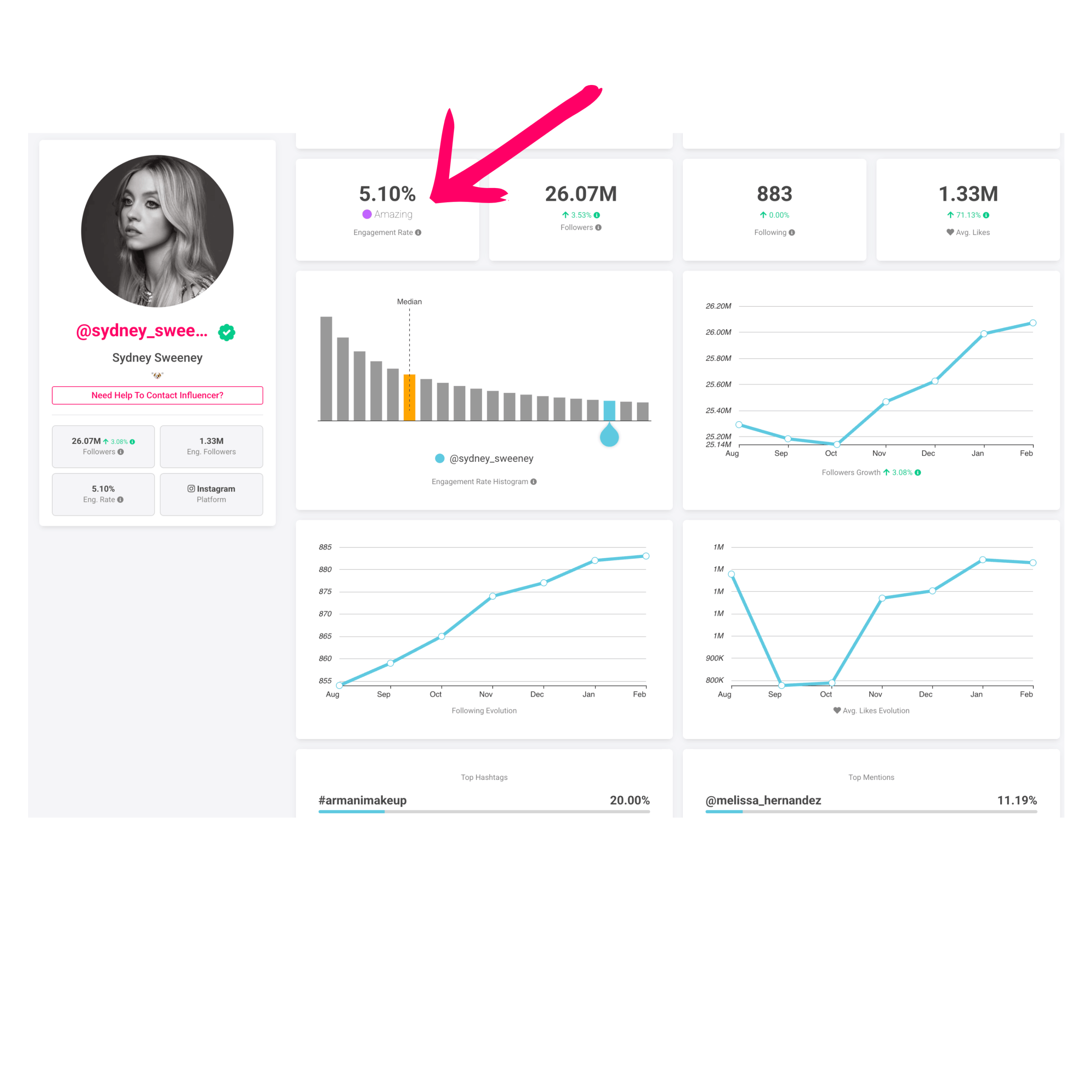
1. Creator Engagement Rate
Creator engagement rate measures the average engagement generated by a creator’s content relative to their audience. You calculate it by adding likes, comments, shares, and saves and dividing by the creator’s followers. You can use this metric to benchmark creators against peers and campaigns.
NOTE: Avoid comparing raw engagement across creators of different sizes without adjusting for the audience.
On Click Analytic, we can both provide average eng. Rate for each influencer or per campaign. See the example below on Sydney Sweeney (and full detailed insights here) 👇
2. Cost per Engagement (CPE)
CPE measures the cost of each interaction with a creator’s content by dividing total campaign spend by total engagements. This helps you evaluate the efficiency of influencer campaigns. Keep in mind that not all likes or shares are equally valuable, so engagement quality matters.
Pro Tip: Understanding CPE allows brands to identify high-impact creators instead of paying for reach that does not drive results.
3. Cost per 1,000 Views (CPM Proxy)
CPM proxy estimates the cost per 1,000 impressions a creator generates by dividing campaign spend by total views and multiplying by 1,000. You can use it to compare creator output against paid media or other creators. Be careful not to assume CPM alone reflects ROI.
4. Creator Authenticity Score
The creator authenticity score combines engagement patterns, follower behavior, and content alignment to assess whether a creator’s audience is real, active, and relevant. Avoid relying solely on follower counts when selecting creators.
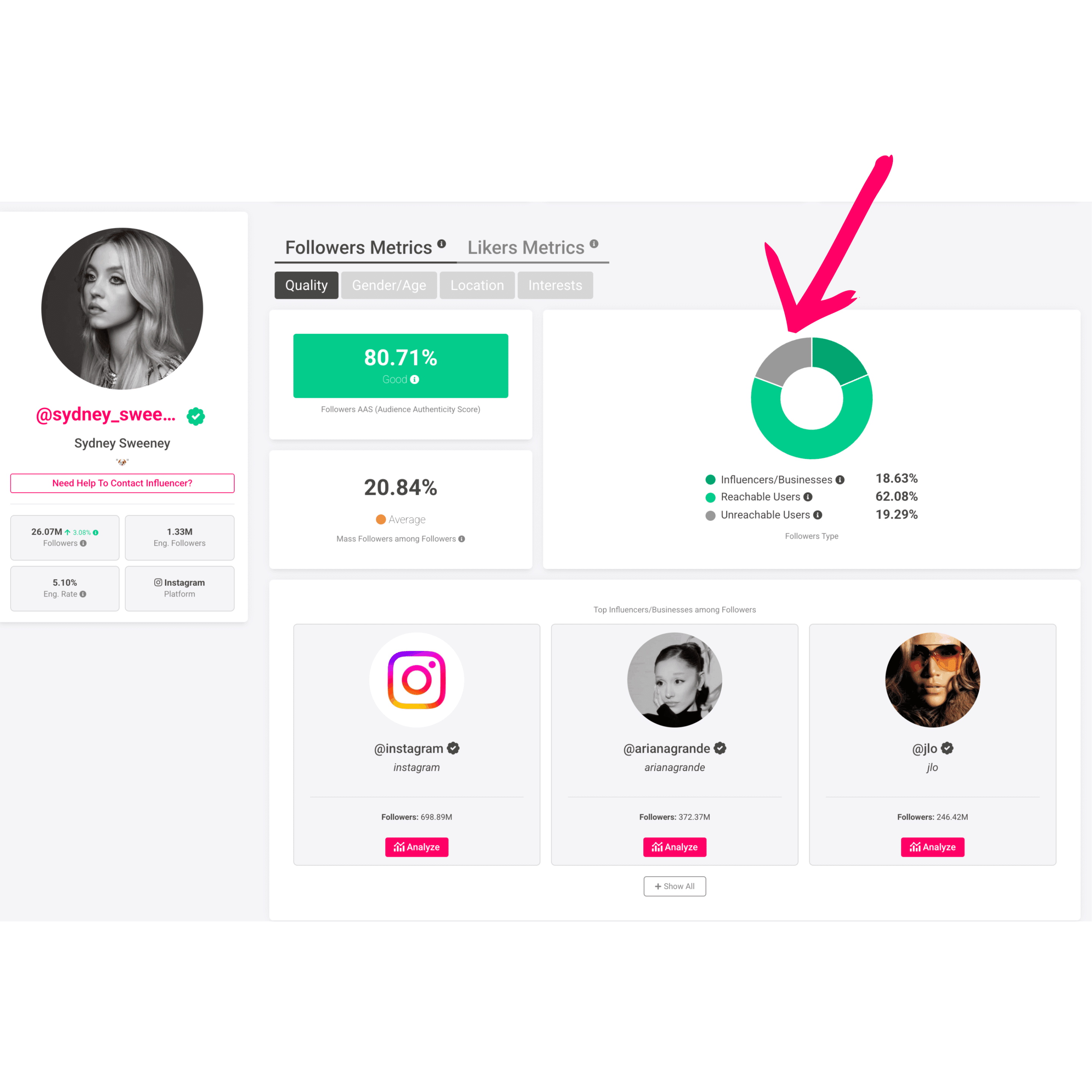
5. Fake Follower Percentage
Fake follower percentage measures the share of a creator’s audience that is inactive, bot-generated, or low-quality.
You can use this metric to avoid wasted spend and inflated performance metrics. Do not ignore fake followers when calculating engagement or reach.
On Click Analytic, one of the Social Media KPIs that we look is Fake Followers and the Audience Quality, which we can get for any celebrity or creators.
See below the example on Sydney Sweeney – or analyze any creator for free here.
6. Creator Audience Quality
Creator audience quality evaluates how well a creator’s followers align with your target market based on demographics, interests, and location. Avoid choosing creators with large but irrelevant audiences.
INTERESTING: Brands with active online communities report 30–50 % higher customer retention and significantly better engagement than brands relying on traditional ads alone.
7. Creator Growth Momentum
Growth momentum measures how quickly a creator’s following grows over time. This is helpful to anticipate potential reach and content virality. Be careful not to focus only on static follower counts while ignoring trends.
Pro Tip: Creators with positive momentum typically get algorithmic amplification and perform well over time.
8. Repeat Collaboration Lift
Repeat collaboration lift is tracking the improvement in performance from working with the same creator multiple times. You can use it to see whether ongoing partnerships drive compounding results. Avoid treating each campaign as fully independent.
9. Creator Burnout Signal
Creator burnout signals a decline in engagement or reach despite consistent posting. This metric helps detect overused creators or saturated audiences. Make sure to monitor performance trends instead of simply increasing posting frequency.
11. Earned Media Value (EMV)
In the world of Social Media KPIs, the EMV might be the most commonly used metric for analysing a creator’s performance.
💡Earned Media Value (EMV) estimates the monetary value of organic exposure generated through influencer or creator content. It allows brands to compare influencer performance with equivalent paid media costs.
EMV is typically calculated using impressions and industry CPM benchmarks:
EMV = (Total Impressions ÷ 1,000) × Average CPM
Example:
If a creator generates 500,000 impressions and your average industry CPM is $10:
EMV = 500,000 ÷ 1,000 × 10 = $5,000
This means the exposure generated organically would have cost approximately $5,000 through paid advertising.
According to industry benchmarks, average social media CPMs generally range between $6 and $15, depending on platform, targeting, and audience quality.
While EMV is not a direct revenue metric, it helps evaluate brand visibility, compare influencer performance, and justify campaign investment alongside engagement and conversion KPIs.
10. Click Analytic Edge
With Click Analytic, brands can automatically track creator content across Instagram posts, Reels, Stories, and TikTok videos.
The platform captures impressions, likes, comments, views, and even sales via UTM links or promo codes. This makes every interaction and conversion measurable, removing guesswork from influencer ROI.
By monitoring both reach and performance, brands can optimize campaigns in real time, identify creators who deliver genuine results, and prevent burnout.
🟢 Audience Quality & Lookalike KPIs
Audience insights are what separate generic influencer campaigns from precision-targeted performance campaigns.
Simply tracking followers or engagement is no longer enough. Nowadays, brands need to evaluate who their audience is, how relevant they are, and how they overlap with other communities.
1. Audience Gender Split
Audience gender split shows the percentage breakdown of your audience by gender.
You can use it to ensure your content and campaigns align with your target demographics. Do not assume all followers are equally valuable without checking the distribution.
2. Age Distribution
Age distribution tracks the percentage of your audience across different age ranges. It is useful for targeting campaigns and optimizing content. Avoid relying solely on average age because distributions reveal pockets of relevance that averages can hide.
3. Top Countries
Top countries measure the geographic distribution of your audience. You can use this for market expansion, localization, or region-specific campaigns. Be careful not to treat all locations as equally valuable.
Pro Tip: Identifying regional opportunities helps optimize ad spend and choose creators strategically.
4. Audience Interests
Audience interests show the topics, categories, or behaviors your audience engages with most. Use this to align content and partnerships with what your audience cares about. Avoid ignoring interest data, as misalignment can reduce campaign effectiveness.
5. Audience Authenticity
Audience authenticity measures the percentage of followers who are real, active, and engaged. This helps validate influencer campaigns and overall audience value. Do not rely on raw follower counts alone.
6. Audience Overlap Percentage
Audience overlap calculates the percentage of shared followers between brands, creators, or campaigns. You can use it for influencer discovery, partnership evaluation, or competitive analysis. Avoid selecting creators without understanding audience redundancy.
Click Analytic Lookalike Example
Click Analytic helps brands compare audiences between brands and creators to see how much they overlap. This makes it easier to understand whether a creator brings new people or simply reaches the same audience again.
For example, Gymshark can compare audiences with Alex Eubank and instantly see how many followers they share. A lower overlap means the creator reaches new but relevant people. A higher overlap shows that much of the audience already knows the brand.
This matters for several key reasons.
✅ Influencer Discovery
Audience overlap helps brands find creators who introduce the brand to new potential customers. Instead of choosing creators based on follower count, teams can focus on creators who expand reach and attract the right audience.
✅ Brand Partnerships
Overlap data shows whether ongoing collaborations still add value. When overlap stays low or moderate, partnerships continue to drive growth. When overlap becomes high, results may plateau, signaling the need for fresh creators or new audiences.
✅ Competitive Analysis
Audience overlap reveals where competitors focus attention. Brands can see which creators competitors rely on, identify crowded spaces, and uncover opportunities to stand out with new partnerships.
🟢 Sentiment & Brand Safety KPIs
Sentiment and brand safety KPIs measure how audiences perceive your brand and whether campaigns avoid reputational risk. For enterprise teams, these metrics are critical to preventing crises, protecting long-term value, and guiding content strategy.
1. Positive vs Negative Sentiment
Positive vs negative sentiment tracks the ratio of positive mentions to negative mentions across social channels. Use it to monitor brand perception and campaign impact. Do not focus only on engagement or reach without considering sentiment.
NOTE: Platforms and audiences favor brands that maintain positive sentiment, and negative spikes can reduce reach and loyalty.
2. Sentiment Trend
Sentiment trend measures how audience perception changes over time, such as daily, weekly, or campaign-specific shifts. Avoid relying on single snapshots because trends reveal emerging issues.
Pro Tip: Tracking trends allows you to adjust content proactively before small issues escalate.
3. Brand Safety Risk
Brand safety risk tracks the exposure of your content alongside unsafe or inappropriate material. Use it for influencer partnerships, paid campaigns, or UGC. Do not assume platforms automatically protect your brand.
4. Controversy Exposure
Controversy exposure measures interactions or mentions related to potentially sensitive topics. You can use it to detect potential backlash from campaigns or creators. Be cautious not to ignore minor controversies, as they can escalate quickly.
5. Crisis Velocity
Crisis velocity measures how fast negative sentiment or issues spread across platforms. Use it for real-time monitoring of PR or campaign risk. Avoid reviewing crises only after they happen.
Pro Tip: Fast-moving crises can reduce trust, revenue, and algorithmic favorability, so early detection is key.
🟢 Customer Care KPIs
When defining your Social Media KPIs, most teams focus on reach, engagement, or conversions.
But social media is no longer just a marketing channel.
It’s a customer support channel.
Today, consumers expect brands to respond on Instagram, X, TikTok, LinkedIn, and even YouTube comments (often faster than email).
According to Sprout Social, over 70% of consumers expect a response from brands within 24 hours on social media, and many expect replies within a few hours.
If you ignore customer care KPIs, you’re missing a critical performance layer of your social media strategy.
Here are the key Customer Care KPIs to track:
1. Response Time
💡Definition: The average time it takes your brand to respond to a comment, DM, or mention.
Why it matters:
Faster responses increase trust, satisfaction, and conversion probability.
Industry benchmark:
• Under 1 hour = excellent
• Under 4 hours = strong
• 24+ hours = risky
Slow response time directly impacts brand perception.
2. Response Rate
💡Definition: The percentage of customer messages your brand responds to.
Formula:
(Number of replies / Total incoming messages) × 100
Why it matters:
If your response rate is below 80%, customers may feel ignored.
High-performing brands aim for 90%+ response rate on public comments and DMs.
3. First Contact Resolution (FCR)
💡Definition: The percentage of customer issues resolved in the first reply.
Why it matters:
Reducing back-and-forth improves customer satisfaction and reduces workload.
Higher FCR = more efficient social support.
4. Customer Sentiment Score
💡Definition: The percentage of positive vs negative mentions about your brand.
You can measure this through:
• Social listening tools
• Manual tagging
• AI-based sentiment analysis
Why it matters:
Sentiment is a leading indicator of brand health.
A spike in negative sentiment often predicts churn or PR issues before they escalate.
5. Customer Satisfaction (CSAT) via Social
Some brands now send quick surveys after resolving a social support case.
Example:
“Was this helpful? 👍 / 👎”
Tracking CSAT from social interactions gives direct feedback on your support quality.
6. Escalation Rate
💡Definition: Percentage of social inquiries that must be escalated to email, phone, or another department.
High escalation rates may signal:
• Poor internal processes
• Lack of social team training
• Product or service issues
Lower escalation rates indicate strong frontline resolution.
Here’s why, among all Social Media KPIs – this is EXTRA relevant:
Social media is where complaints go viral.
One ignored comment can turn into:
• Negative influencer reviews
• Public backlash
• Declining brand trust
But fast and helpful responses can turn frustrated customers into advocates.
Customer care KPIs protect revenue.
They reduce churn.
They increase retention.
And retention often has a greater financial impact than new customer acquisition.
That’s why modern Social Media KPIs must include customer care performance ; not just marketing metrics.
🟢 Paid & Organic Interaction KPIs
Paid and organic KPIs show how growth strategies interact and amplify each other. Modern marketing teams use these metrics to improve efficiency, creative output, and cross-channel performance.
1. Organic-to-Paid Lift
Organic-to-paid lift measures the percentage improvement in paid campaigns driven by prior organic content. Do not evaluate paid results in isolation.
Insider Tip: Cohesive organic and paid signals improve amplification and performance across platforms.
2. Boost Efficiency Ratio
Boost efficiency ratio calculates incremental engagement from boosted content relative to cost by dividing incremental engagements by boost spend and multiplying by 100. Avoid ignoring the contribution of organic content to the boost.
3. Creative Scalability Score
Creative scalability score measures whether a creative concept performs across multiple paid and organic campaigns. Avoid running one-off campaigns without testing replicability.
4. Paid Fatigue Crossover Point
Paid fatigue crossover point identifies when paid audience engagement declines due to repeated exposure. You can use this to rotate creatives, audiences, or campaigns proactively. Do not continue spending beyond the point of effectiveness.
🟢 Operational & Team KPIs
Operational KPIs track internal efficiency, team performance, and campaign execution speed. Often overlooked, they have a direct impact on ROI and scalability.
1. Content Cost per Post
Content cost per post measures the average cost of producing a single piece of content by dividing the total production cost by the number of posts. Do not forget hidden costs like editing, approvals, or creator fees.
Expert Tip: Reducing cost while maintaining quality improves ROI for both paid and organic campaigns.
2. Cost per 1,000 Impressions
Cost per 1,000 impressions measures production or promotion cost per 1,000 views. Avoid evaluating engagement alone without considering cost.
3. Approval Cycle Time
Approval cycle time tracks the average time to review and approve content before publishing. Treat approvals as part of production, because delays can slow campaigns.
4. Creator Onboarding Time
Creator onboarding time measures how long it takes to integrate a creator into your workflow. Note that efficient onboarding accelerates performance and reduces opportunity cost.
5. Reporting Latency
Reporting latency tracks the time between data collection and actionable insights. Avoid making decisions based on outdated reports.
🟢 Predictive & Strategic KPIs
Predictive KPIs give brands foresight into performance trends and potential outcomes, keeping campaigns ahead of algorithms and competitors.
1. Early Velocity Score
Early velocity score measures initial engagement relative to a benchmark. Avoid ignoring early trends and optimizing too late.
2. Growth Momentum Index
Growth momentum index is a composite metric tracking follower growth, engagement acceleration, and creator performance over time. Do not rely only on static metrics.
3. Engagement Acceleration
Engagement acceleration tracks how interactions increase per hour or day after posting. Avoid waiting for cumulative metrics instead of reacting in real time.
4. Format Breakout Probability
Format breakout probability estimates whether Reels, Shorts, or TikTok trends will probably outperform others. Do not treat all formats equally without historical data.
How to Build a Social Media KPI Dashboard That Actually Drives Decisions
A social media KPI dashboard is useless if it doesn’t lead to decisions. Nowadays, marketing teams deal with automated reports, exported spreadsheets, and real-time charts, but still struggle to answer one question: what should we do next?
1. KPI Hierarchy
Not all metrics are equal. A smart dashboard reflects a hierarchy of social media KPIs:
- Primary KPIs: One metric per marketing goal that determines success or failure. If this number moves, strategy decisions change.
- Supporting KPIs: 2–4 metrics that explain or influence the primary KPI (e.g., CTR, engagement rate, view-through rate). These explain why the primary KPI moved. They guide optimization, not reporting.
- Context KPIs: Optional metrics that help interpret trends but do not drive decisions (e.g., impressions, follower count). These provide background but should never trigger strategy changes on their own.
This hierarchy ensures executives and team members focus on what actually moves the business rather than chasing every number on a report.
2. One Dashboard Per Goal
Each marketing goal deserves its own dashboard. Combining awareness, engagement, and conversion metrics into a single dashboard often confuses signals and creates noise.
- Awareness Dashboard: Reach, impressions, discovery rate, and non-follower reach %.
- Engagement Dashboard: Engagement rate, save-to-reach ratio, conversation depth.
- Traffic Dashboard: Link clicks, CTR, traffic quality score.
- Conversion Dashboard: Conversions, revenue, cost per conversion, ROAS.
- Retention Dashboard: Repeat engagement, LTV of social-acquired users, audience loyalty signals.
Segmentation by goal lets teams quickly identify what’s working, what’s lagging, and where to allocate resources.
3. Weekly vs Monthly KPIs
Weekly KPIs
Monitor short-term performance signals such as early velocity, engagement acceleration, and individual content results. Frequent tracking helps teams identify performance shifts early and adjust distribution, creatives, or timing before budget and effort are wasted.
For instance, a decline in engagement velocity during the first 48 hours often indicates weakening algorithm distribution, prompting immediate optimization.
Monthly KPIs
Measure long-term impact, including revenue, customer lifetime value, retention trends, and creator performance. These indicators reveal whether campaigns generate sustained business value or only temporary spikes.
Together, weekly and monthly KPIs balance real-time optimization with long-term strategic direction.
What to Show Executives
Executives don’t need a dashboard full of every metric. Focus on:
- Primary KPI for each goal
- Top 2–4 supporting metrics per goal
- Revenue, conversion, and retention insights
- Creator performance and attribution (where relevant)
- Trends rather than isolated numbers
The dashboard should tell a story: Are campaigns moving the needle? Which channels and creators contribute most? What adjustments are required?
If executives cannot understand performance in 30 seconds, the dashboard is complex.
5 Common Social Media KPI Mistakes
Even the best teams can fall into traps that make dashboards misleading or meaningless. Understanding these mistakes helps you design smarter reports and make actionable decisions.
It’s important to avoid critical mistakes when looking at social media KPIs.
Let’s uncover ⬇️
1. Chasing Vanity Metrics
Metrics like likes, raw views, and follower counts look impressive but rarely correlate with business outcomes.
❌ Mistake: Celebrating a viral post with 2M views but zero conversions.
✅ Fix: Focus on context-rich KPIs such as saves, shares, and conversion-attributed content.
2. Over-Reporting
Too many metrics create noise and slow decision-making. Weekly dashboards should focus on actionable signals, not every available number.
❌ Mistake: Reporting 50+ metrics without hierarchy.
✅ Fix: Apply KPI hierarchy: primary, supporting, and context KPIs.
3. No Creator Tracking
Influencer and creator content often drives performance behind the scenes. Ignoring creator KPIs leads to missed attribution and inefficient spend.
❌ Mistake: Counting only branded posts and paid ads while ignoring creator content.
✅ Fix: Track creator impressions, engagement, conversions, and revenue automatically (e.g., Click Analytic).
4. No Attribution
Without connecting metrics to outcomes, dashboards fail to measure true business impact.
❌ Mistake: Measuring CTR, engagement, or reach without tying results to revenue or conversions.
✅ Fix: Implement multi-touch attribution and track assisted conversions to show which channels and creators actually contribute to business goals.
5. Measuring Platforms in Isolation
❌ Mistake: Evaluating Instagram, TikTok, and creator performance separately without understanding cross-platform influence.
✅ Fix: Use audience overlap and cross-channel attribution to identify how exposure on one platform drives performance on another.
FAQs About Social Media KPIs
Which KPIs matter most?
The most important social media KPIs depend on your marketing goal. Awareness campaigns focus on reach and impressions. Conversion campaigns prioritize revenue, conversion rate, and ROAS. Context determines relevance.
How often should KPIs be reviewed?
Review social media KPIs weekly for short-term trends and monthly for long-term performance. Weekly checks allow optimization, while monthly reviews show if campaigns are compounding results.
What are the most important KPIs for social media?
Key social media KPIs vary by goal:
- Awareness: Reach, impressions
- Engagement: Engagement rate, saves, shares
- Traffic: Link clicks, CTR
- Conversions: Conversions, ROAS, revenue
- Retention: Repeat engagement, LTV of social-acquired users
How do you measure social media KPIs?
To measure social media KPIs you can use platform analytics, tracking links, UTM parameters, and tools like Click Analytic. Align metrics with marketing goals to measure performance meaningfully.
What are examples of social media KPIs?
Examples of social media KPIs include reach, impressions, engagement rate, CTR, conversions, revenue per post, creator engagement rate, audience overlap %, and sentiment trend. Each social media KPI signals performance at a different funnel stage.
Are follower counts still relevant?
Among all the social media KPIs, Follower counts are regarded mostly as vanity metrics.
In 2026, algorithms prioritize engagement, retention, and relevance.
High follower numbers only matter if the audience is active, authentic, and aligned with goals.
How do you measure influencer ROI?
Track engagement, reach, conversions, and revenue directly attributed to creators.
For example, let’s look at an example 👇
If your influencer campaign cost $12,000 and generated $36,000 in attributable revenue:
ROI = (36,000 − 12,000) ÷ 12,000 × 100 = 200% ROI
According to HubSpot’s State of Marketing Report, nearly 49% of marketers say social media helps generate revenue, reinforcing the importance of tracking ROI instead of engagement alone.
The best way to track an Influencer ROI? Use tools. It will calculate it for you.
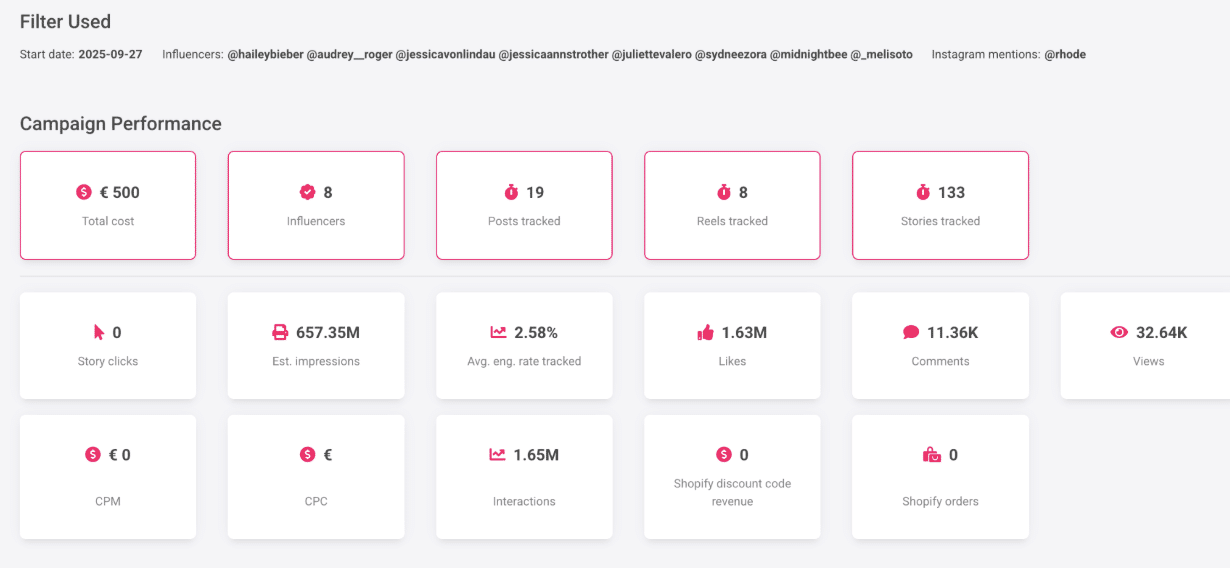
For example, tools like Click Analytic automate tracking across Instagram, TikTok, and more, linking posts to sales via UTM links or promo codes.
Below is an example of a campaign tracked inside Click Analytic, where you can see the budget spent, the number of content tracked, the reach on the campaign, views and more.
Depending on your business goals, tools like Click Analytic can help you track your social media KPIs.
What is a KPI in marketing?
A marketing KPI is a measurable indicator used to track campaign success. It connects specific actions, like clicks or conversions, to business outcomes.
What are Instagram KPIs?
Key Instagram KPIs include Reels view rate, saves per reach, story completion rate, and profile action rate. These social media KPIs measure engagement, retention, and audience behavior.
What are Facebook KPIs?
Core Facebook KPIs include reach, impressions, engagement rate, CTR, link clicks, and conversions. These metrics track visibility, interaction, and business impact.
What is the difference between social media metrics and KPIs?
Metrics are any measurable data points, like likes or followers. Social media KPIs are the metrics that align directly with your goals and measure campaign success. Context determines their importance.
How do businesses track KPIs for social media?
Businesses track social media KPIs using platform analytics, tracking links, dashboards, and tools like Click Analytic. Automated tracking and attribution connect social activity to business outcomes.
If you need clarity on metric terms like CTR, CPM, or EMV, explore our complete social media acronyms glossary.
Turn Social Media KPIs Into Campaigns That Actually Deliver Results
Social media KPIs aren’t just numbers.
They show what’s working, what’s falling short, and where your time and budget have the biggest impact.
Tracked with context, social media KPIs become a roadmap for smarter campaigns, stronger engagement, and measurable business growth.
The key is to align social media KPIs with your goals!
How?
Focus on the metrics that matter for awareness, engagement, traffic, conversions, or loyalty and ignore the rest. Understanding audience quality, creator performance, and audience overlap ensures you invest in results, not vanity numbers.
Tools like Click Analytic make this effortless. Automatically track creators, measure authentic audience behavior, and see how each interaction contributes to real outcomes. This gives clear insights, faster decisions, and campaigns that drive actual business impact.
Looking to track Social Media KPIs from influencers? Register for FREE today!