No generator gives real likes. What the free ones actually take, what TikTok's terms say, and the measured reason likes are the wrong thing to chase.
By Jules CarmauxMarketing tips
Quick answer
No generator gives you real TikTok likes. The sites that promise them want a login, a survey completion, or an app install, and TikTok's own Terms of Service say handing your password to a third party is your risk, not theirs.
Likes follow views. When a video reaches people, a normal share of them like it, and almost every account already gets that share. The hard part is getting the video seen: of 1.7 million US TikTok accounts we measured, only 13 in 100 average as many as 10,000 views on a video.
What a free TikTok likes generator actually does
Almost everyone reading this page searched for a generator, a bot, or "1000 likes free". So start there, because the answer is specific and it is worth knowing before you type your username into anything.
Every one of these sites works the same way. The steps are always in this order.
It asks for your username, not your password. This part is real and harmless. It is there to make the next step feel normal.
It shows a fake progress bar. "Connecting to server", "injecting likes", a counter ticking up. Nothing is happening. The animation runs on a timer written into the page.
Then comes the ask. One of three things, and it is always one of these three:
Human verification. Complete an offer, install an app, take a survey. The site is paid per completion. You are the product; the likes were the bait.
A login. Now it wants the password, or a "TikTok login" screen that is not TikTok. This is the one that costs you the account.
A code. It sends a real login code to your phone and asks you to type it in. Anyone asking for that code is trying to log in as you, right now.
If likes appear at all, they are from dead accounts. Empty profiles, no posts, no followers. They inflate a number and nothing else.
Click Analytic, with TikTok Terms of Service, September 2026.
None of these steps require you to be careless. The flow is designed so that by the time the real ask arrives, you have already invested five minutes and a username, and stopping feels like wasting the effort. That is the whole trick.
What TikTok's terms say about handing over your login
This does not need a warning from a consumer body. TikTok's own Terms of Service cover it in plain language, and they are worth reading once because four separate clauses apply.
What the terms say
What it means for you
Keep your password confidential and do not disclose it to any third party
A likes site asking for a login is asking you to break the terms
You are solely responsible for the activity that occurs under your account
Whatever the tool does next is treated as something you did
TikTok may disable your account at its own discretion for a breach
There is no appeal built on "I did not know"
You may not use automated scripts to interact with the Services
A likes bot is the exact thing this clause names
TikTok is not liable for loss caused by your failure to keep your password confidential
If you lose the account this way, that is stated in advance as not their problem
TikTok Terms of Service, checked September 2026.
The last line is the one people miss. TikTok wrote down, in advance, that a loss caused by giving away your password is not something they will cover. You are not one support ticket away from getting the account back.
What to do if you already used one
If you typed a password or a code into one of these sites, do these four things now, in this order. The order matters because each step closes a door the previous one leaves open.
Change your TikTok password first, from inside the app. Settings, then Account, then Password. Do it before anything else, because every other step is pointless while someone else knows the current one.
Sign out of all other devices. Settings, Security and permissions, Manage devices. Anything you do not recognise, remove it. A stolen password is often used to keep a session alive rather than to change anything visible.
Turn on two-step verification. Same Security menu. This is what stops a repeat, because a password alone stops being enough.
Change the password on the email address attached to the account, and turn on two-step there too. If the attacker reaches the email, they can reset TikTok whatever you do inside TikTok.
Then check three places for damage that is easy to miss:
Your bio and links. Hijacked accounts are usually monetised by editing the bio to point somewhere else, not by posting.
Your drafts and scheduled posts.
Your linked accounts under Settings, Account, and any third-party app still holding access.
If the account is already gone, TikTok's recovery path runs through the login screen's "Forgot password" and then their feedback form. Be realistic about it: TikTok's Terms say in writing that they are not liable for a loss caused by not keeping your password confidential, so recovery is a request, not an entitlement.
The number that changes the question
Here is the part no other guide on this query will tell you, because it needs a database to see.
We measured every United States TikTok creator account between 10,000 and 100 million followers. That is 1,747,347 accounts, plus another 11.3 million below 10,000 followers.
What we measured
Share of US TikTok creators
Engagement rate above 1%
97.8%
Engagement rate above 3%
91.2%
Engagement rate above 5%
77.9%
Averages 10,000 views a post
13.0%
Averages 100,000 views a post
2.4%
Averages 1,000,000 views a post
0.3%
Click Analytic, 1,747,347 United States TikTok accounts above 10,000 followers, September 2026.
Engagement rate here just means the share of the people who watched a video who then did something: liked it, commented, or shared it. Read the two halves of the table against each other.
Nearly four in five creators already get a good share of reactions. Only one in eight gets ten thousand views. On TikTok, likes are not the scarce resource. Views are. Reactions are high across the board because TikTok only puts a video in front of people it thinks will react to it. It has already filtered the audience for you.
Which means a free likes generator sells you the metric you already have, and cannot sell you the one you are missing.
Click Analytic data, September 2026.
Where TikTok views actually come from
Since the whole page turns on views being the scarce thing, it is worth being precise about how a video gets them.
TikTok does not distribute by follower count. It shows a new video to a small group first, watches what they do, and decides from that whether to show it to a larger one. Your followers are a part of that first group, not the whole of it, which is why a small account can out-reach a large one and why the median engagement rate barely moves between 10,000 followers and 250,000.
What that first group's behaviour is judged on, in rough order of weight:
Whether they watch it to the end. This is the strongest single signal, which is why a 12-second video that holds attention often travels further than a 45-second one that says more.
Whether they watch it twice. A rewatch counts more than a view.
Whether they share it. A share puts the video in front of a person TikTok did not choose, which is the strongest vote a viewer can cast.
Whether they comment, and whether the comments are conversations rather than single emoji.
Whether they like it. Real, and the weakest of the five, because it costs the viewer nothing.
That order is the reason this page exists. The metric that is easiest to buy is the one that matters least, and the two that matter most, completion and shares, cannot be bought at all because they require somebody to actually watch.
A practical consequence. If a video gets views but few likes, the problem is usually length or payoff position, not the audience. Cut the same idea to two thirds of the length, move the payoff earlier, and post it again. Nothing about that is a trick; it is the same idea given a fairer test.
What a normal TikTok engagement rate actually is
Most guides on this subject quote a range like "6 to 10% is solid". That is below the median, and this page said it until today.
Follower band
Median engagement rate
Accounts measured
10K to 50K
8.17%
1,383,801
50K to 250K
7.53%
293,634
250K and above
7.41%
69,915
Click Analytic, United States TikTok accounts, September 2026. Median means the middle account: half are above the figure and half below.
Two things follow.
Engagement falls as accounts grow, and only slightly. From 8.17% down to 7.41% across the whole range. Follower count barely moves engagement on TikTok, which is why follower count is a poor thing to optimise for and an even poorer thing to buy.
And the median views figure for the largest band is the one to sit with: a US creator with 250,000 or more followers has a median of 13,497 views a post. Not millions. Thirteen thousand.
The formula, and how to run it on your own account
On TikTok you divide by views, not by followers, because TikTok shows videos to people who do not follow you. Dividing by followers would flatter a small account and punish a large one.
(likes + comments + shares) ÷ views × 100
Worked through with real numbers. A video with 24,000 views, 1,900 likes, 68 comments and 42 shares:
Add the interactions: 1,900 + 68 + 42 = 2,010
Divide by views: 2,010 ÷ 24,000 = 0.0838
Multiply by 100: 8.38%
That account is just above the median for its size. Do this for the last ten videos and take the middle value, not the average, because one video that travelled will drag an average upwards and tell you nothing about a normal week.
The follower-based version, (likes + comments + shares) ÷ followers × 100, is what most calculators use and what brands quote on Instagram. On TikTok it inflates small accounts and punishes large ones, because a TikTok video's audience has very little to do with the follower count.
What actually gets you more likes, in the order that matters
This is the part people skip to, so here it is with the effect size attached rather than as a list of tips.
Posting at all beats every growth tactic, because half the market has stopped
Of those 1.7 million US accounts, only 50.6% posted anything in the last 30 days. Half the creators competing with you are dormant.
This is the largest and least glamorous lever on the page. Not a hook formula, not a hashtag set. An account that posts three times a week for a month is ahead of half its market on the only input it fully controls.
Why the first two seconds decide how far a TikTok travels
TikTok decides how far a video travels from what happens in the first seconds. Concretely:
Open on the result, not the setup. "Here is the one that survived" beats "Hi guys, so today I tested".
Put the subject on screen immediately. A face, the product, the finished thing. Not a title card.
Say what the video is in the first line of speech. Viewers who know what they are watching stay to find out how it ends.
Cut the greeting. Every second of "welcome back to my channel" is a second in which someone can leave.
How to make a TikTok work with the sound turned off
A large share of viewing happens muted, which is why on-screen text is not decoration.
Burn in captions. TikTok's auto-captions are enough; edit the words it gets wrong.
Put the key claim on screen as text, not only in the audio.
Keep text out of the bottom third and the right edge, which is where TikTok's own interface sits.
When to ask for the like, and how often to ask
A like is a small favour. Asking works, asking badly does not.
Ask once, near the payoff, not at the start.
Attach it to something: "like this if you want part two" gives a reason.
Put the ask in on-screen text as well as speech, for the muted half.
Never ask three times. It reads as desperate and viewers leave.
Why replying in the first hour is worth more than the likes are
Comments are worth more than likes both to the algorithm and to you, and replies produce more comments. Replying with a video is stronger still, because it becomes a new post that carries the original's audience with it.
How to re-post an idea that failed without repeating yourself
A video that failed is not always a bad idea. It is often a bad first two seconds. Take the three ideas that did best in the last month and rebuild them: different hook, different opening frame, same substance. This is how creators with small audiences find the format that works, and it costs nothing.
What accounts that actually get views look like
We pulled a sample of 100 United States TikTok creator accounts from our database and looked at one ratio: average views divided by follower count. It is the cleanest way to see whether an account's videos travel beyond the people who already follow it.
Sixty-one of the hundred average more views than they have followers. On TikTok that is normal, and it is the whole reason follower count is a weak thing to buy.
The extremes are where the lesson is.
Account
Followers
Average views
Views per follower
@landreemcalley
21,100
1,200,000
57x
@reallyleilaa
87,200
2,700,000
31x
@skibidi.danikaxo
15,500
485,350
31x
@amisamazinglifespam_
105,000
1,400,000
13x
The largest accounts in the sample
about 1,000,000
about 250,000
0.25x
Click Analytic, a sample of 100 United States TikTok creator accounts, August 2026.
Click Analytic, 100 United States TikTok accounts, August 2026.
Read the first row against the last. An account with 21,100 followers averages roughly five times the views of accounts with a million. Not once, on average.
That is the answer to the question this page is about, stated as plainly as it can be. The accounts winning on TikTok are not the ones with the biggest follower numbers, and no amount of buying followers or likes moves the ratio that actually matters. A bought follower does not watch anything.
Two more things the sample shows:
The median engagement rate here is 11.14%, higher than the 8.17% market median, because this sample skews towards accounts whose videos travel. High engagement follows views; it does not cause them.
Not one account in the sample averages under 10% of its follower count in views. Even the weakest performers are reaching a quarter of their following per post. The floor is higher than most creators assume, which means a low view count is usually a content problem, not an account problem.
Four posting methods that actually move the view count
These are the methods that survive contact with how TikTok distributes, described concretely enough to run this week.
Method one: post the same idea three ways and let the data choose
Take one idea. Make three versions that differ only in the first three seconds: one opens on the result, one opens on the problem, one opens on a question. Same middle, same ending. Post them across a week.
You are not hoping one goes viral. You are running a test where the only variable is the opening, and TikTok's first-group mechanism gives you a clean read within hours. Keep the winner's opening pattern and use it for the next month.
Method two: build the video backwards from the last line
Write the payoff first. Then work out the shortest possible path to it. Most videos that fail are not badly made, they are badly ordered: the interesting part arrives at second twelve and the audience left at second four.
A practical rule: if you can move a sentence from the end to the beginning without breaking the video, it belonged at the beginning.
Method three: answer your own comments as new videos
When a video does reasonably well, its comments are a list of things a real audience wanted to know, written by people who already watched you. Pick the comment with the most likes and make it the next video, with the comment on screen.
This works for two reasons that are mechanical rather than clever. The new video inherits interest from the first, and TikTok surfaces the reply format to people who saw the original. It is the cheapest reliable second video anyone has.
Method four: post a series, not a set of one-offs
A numbered series gives a viewer a reason to look at your profile, and a profile visit is worth more than a like because it can produce a follow. It also lets a video that lands carry the ones before it: someone who finds part four goes back for parts one to three.
Keep the parts genuinely separate. A series where each part needs the last one is a video that was cut into pieces, and viewers notice.
Hashtags, sounds and posting times, honestly
Three things get asked constantly on this subject, and the honest answers are shorter than the advice usually given.
Hashtags. They help TikTok categorise a video; they do not summon an audience. A useful set is two or three that describe the actual subject and one broader one. What does not work is stacking twenty, or using unrelated high-volume tags, which tells TikTok to test the video on people who did not want it and then hands you a weak first-group result.
Sounds. Using a sound that is currently travelling can genuinely help, because TikTok surfaces videos by sound as well as by subject. Two conditions: the sound has to fit what you are actually showing, and you have to be early. A sound that has been in the feed for two weeks is no longer an advantage. If you record with the sound selected first, the sound also sets the video's length.
Posting times. The advice you will read is invented with a confidence nobody has earned. TikTok has never published a best hour, and the small test audience for a video is put together when you post it, not at some fixed time of day. What is real: your own audience's active hours are in your account analytics under Followers, and posting when they are awake gives the first group a better chance of being people who like your subject. Use your own numbers, not a chart from a blog.
Video length. There is no optimal number. Longer videos hold more information and complete less often; shorter ones complete more and say less. The measurable thing is your own completion rate, in analytics, per video. Chase that rather than a length.
How the paid likes industry actually works
Nobody needs the names of these sites, and this page will not give them. What is worth knowing is the shape of the business, because once you see it the offer stops being tempting.
There are only a few suppliers, and everyone else is a reseller
Almost every site selling likes is a storefront on top of a wholesale panel. The panel holds the actual supply; the storefront marks it up and builds a checkout. This is why the offers look identical everywhere: the same tiers, the same wording, the same promises. You are not choosing between services. You are choosing between resellers of the same stock.
"High quality" and "real looking" are product tiers, not descriptions
The cheap tier is bots on empty accounts. The expensive tier is bots on accounts that have a profile photo, a few posts, and some followers of their own, which are often hijacked accounts belonging to real people who lost a password to exactly the kind of site described at the top of this page.
That is the actual supply chain. The expensive likes are more convincing because they come from accounts that were stolen rather than created.
Click Analytic, the pattern an audience check looks for, September 2026.
Drip-feed exists because instant delivery is obvious
Every panel offers to spread delivery over hours or days. That option exists for one reason: a post that goes from 40 likes to 4,000 in ten minutes is visible to anyone who looks at the account's history. Drip-feed is a confession that the product needs to be hidden.
The refill guarantee tells you the likes disappear
Panels advertise a 30-day or 90-day refill. Read what that promises. It promises that some of what you bought will be removed, and that they will top it back up. You are buying something with a known decay rate.
What our platform sees when an account buys engagement
This is the part we can speak to directly, because it is what we are paid for. Brands run creator accounts through our checks before they sign anything, and bought engagement does not survive that.
A viewer scrolling past sees a number. What a vetting tool sees is the shape of the account, and the shape is wrong in ways that are hard to fake all at once:
Likes that do not match views. A video with 4,000 likes on 9,000 views is a 44% engagement rate. The median in our US data is 8.17%. Nothing organic sits five times above its own market.
A step in the history. Real accounts drift. Bought accounts have a date where the numbers change level and stay there.
Comments that do not follow. Likes are cheap and comments are expensive, so bought accounts have the ratio backwards. Real audiences argue and ask questions; bought ones leave fire emoji or nothing.
An audience in the wrong place. The audience country stops matching the creator's country, because supply is cheapest where labour is cheapest.
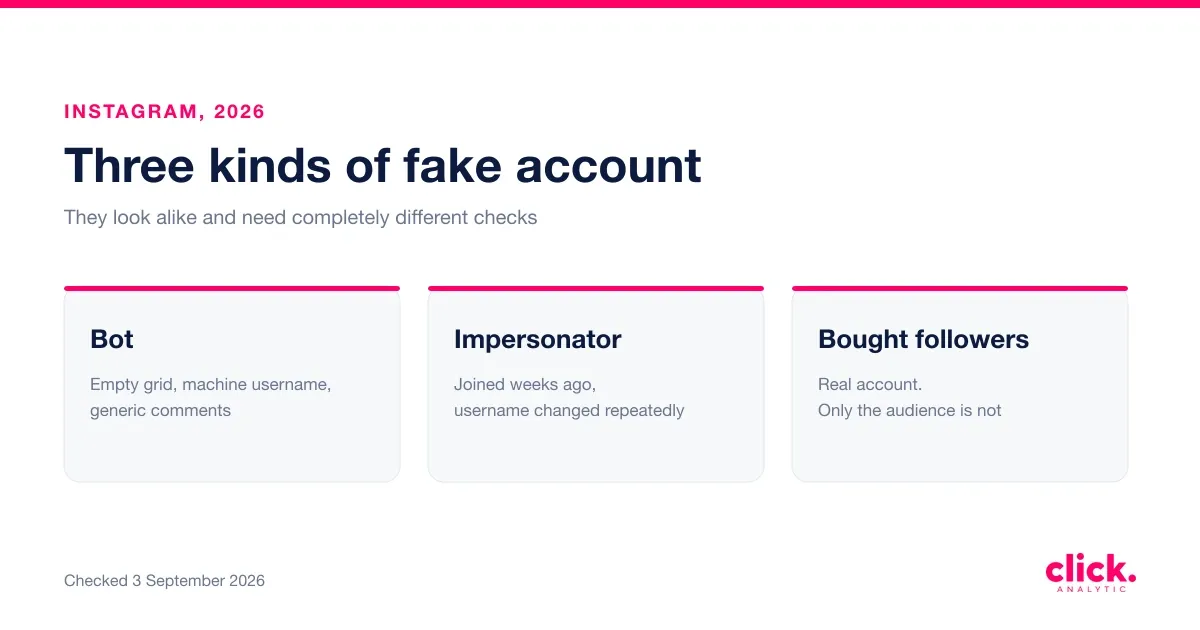
Followers with no history. Empty profiles, no posts, no followers of their own, created in batches within days of each other.
None of this needs a confession or an admission. It is visible in the numbers, it is visible for as long as the account exists, and it is the first thing a brand looks at. We publish the check for free: run any public account through the TikTok fake follower checker and look at the audience quality score rather than the follower count.
The practical point for a creator: the spike lasts a week and the record lasts for years. A brand deciding in 2027 will be looking at a graph that still has the step in it.
Buying likes is not just against the rules, it is against the law in the US
TikTok's terms are one thing. Federal rule is another, and most guides on this subject have not caught up with it.
> prohibits anyone from selling or buying fake indicators of social media influence, such as followers or views generated by a bot or hijacked account
Three things in that sentence matter.
Buying is covered, not only selling. The creator is not a bystander in the transaction.
"Hijacked account" is named. The FTC is describing the same supply chain as the section above.
The rule carries civil penalties. The FTC said plainly that case-by-case enforcement without penalty authority was not enough of a deterrent, which is why the rule exists.
It applies where the buyer knew or should have known the indicators were fake and where they misrepresent influence for a commercial purpose. A creator buying likes to look bigger to brands is the case the rule describes.
The routes that are free but not honest
Three things sit between organic reach and buying likes outright. They are worth naming because they are not obviously wrong.
Engagement pods. A group that agrees to like each other's posts. Free, and it does produce likes. It also produces engagement from accounts with no interest in your subject, which is exactly the pattern a brand's checks pick up. TikTok's terms name "trading reviews with other users" among prohibited uses.
Follow-for-follow and like-for-like. The same problem with a worse audience. You end up with followers who followed to be followed back and never watch anything.
Giveaways for likes. Legal, allowed, and effective at producing a spike. The likes are real people who wanted the prize. Whether they stay depends entirely on whether the prize was related to your subject. A giveaway of your own product recruits an audience; a giveaway of an iPhone recruits people who like iPhones.
None of these will get an account banned on their own. All of them cost you the thing likes are supposed to prove, which is that people who saw your work liked your work.
If you are a brand reading this query
Buyers land on this page too, and for the opposite reason. You are not trying to get likes; you are trying to work out whether a creator's likes mean anything before you pay them.
The measurements above are your baseline. A US creator quoting a 6% engagement rate is below the median for every size band. A creator quoting 25% has either a very small, very tight audience or a problem.
What to check, in order:
Views, not followers. Ask for the median views of the last ten posts. Only 13% of US creators average 10,000 views; if the follower count says 200,000 and the views say 4,000, the followers are the wrong number to be paying for.
The comment-to-like ratio. Real audiences argue, ask, and mention the product. A wall of emoji under a high like count is the signature of bought engagement.
Whether the account posts. Half of them do not. A creator who posted twice this quarter cannot deliver a campaign.
Audience quality. Run the handle through our TikTok fake follower checker and look at where the audience actually lives.
Only 23.9% of these accounts have run branded content before. That is not a warning sign, it is the market: three quarters of creators have never done a deal, and many of them are cheaper and more careful than the ones who have.
Yes, from real people who watch and like your video. No, from a generator. Every free likes site follows the same flow: username, fake progress bar, then a demand for a survey completion, a login, or a verification code. The likes that do appear come from empty accounts.
No. They ask for a login or a login code, and TikTok's Terms of Service say you must keep your password confidential, that you are solely responsible for activity on your account, and that TikTok is not liable for losses caused by failing to keep your password secure. Losing an account this way is stated in advance as not their problem.
By getting a video in front of enough people, since likes follow views. Our measurement of 1.7 million US creator accounts found the median engagement rate for accounts between 10,000 and 50,000 followers is 8.17%, so roughly 12,000 views produces about 1,000 interactions. The work is in the views, not the likes.
Above the median for your size. In our US data the median is 8.17% for 10K to 50K followers, 7.53% for 50K to 250K, and 7.41% above 250K. Guides quoting 6% as solid are describing the bottom half of the market.
Likes from accounts with no interest in your subject give TikTok a misleading signal about who to show the video to next. The measurable risk is not a ban, it is that the video gets pushed to an audience that does not want it and stops travelling.
Because the video reached people who were not the right audience, or the payoff came too late. Do the sum: the middle account gets reactions from about 8 in every 100 viewers, so 10,000 views and 200 likes is 2 in 100. TikTok found people for you and the video did not hold them.
They are free and the likes are real accounts, but the engagement comes from people with no interest in your subject, which is the exact pattern a brand's checks pick up. TikTok's terms also name trading engagement among prohibited uses.
Buying has the same defect as a generator with an invoice attached. It inflates the metric that our data shows is already common, leaves the metric that is actually scarce untouched, and shows up in any audience-quality check a brand runs before paying you.
None in particular. TikTok distributes by video, not by account, which is why the median engagement rate barely moves between 10,000 followers and 250,000. An account with 250,000 followers has a median of 13,497 views a post in our data.
Post. Only 50.6% of the US creator accounts we measured posted anything in the last 30 days, so consistency alone puts you ahead of half the market on the one input you fully control.
Try our Influencer Marketing Platform for free
Find Influencer email addresses and Contact Influencers with Click Analytic Influencer marketing software.
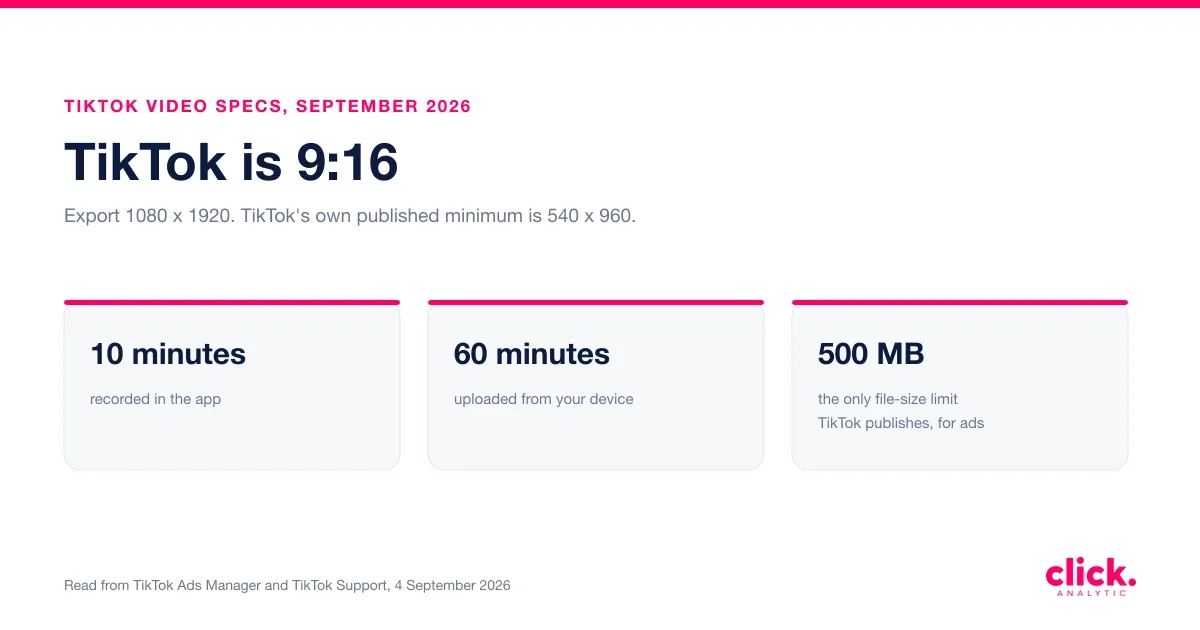
TikTok's aspect ratio is 9:16 at 1080 x 1920. The full spec sheet read from TikTok's own Ads Manager and support pages, the two published length limits, and the numbers TikTok has never published at all.