
The best time to post on YouTube Shorts is between the afternoon and early evening. This usually falls around 12–3 PM and 7–10 PM (local time).
This is because during these time windows, people are more naturally scrolling on their phones between breaks and leisure.
❌ However, factors vary per niche and industry, and so the “best time” greatly differs as well. Testing and using data from YouTube Studio most accurately identifies the optimal time for each YouTube channel.
It’s exactly what we’ll cover in this article, but using a different approach than any other guides…
Let me explain 👇
First, we all know how frustrating it gets when you post during the “most ideal hours” of the day on YouTube Shorts, avoid the “worst hours”, they say, and nitty-grittingly follow that sleek chart – and yet, your metrics stay flat?
Yes, timing matters for the best traffic results on YouTube Shorts. Just not in the copy-and-paste way most guides suggest. What works for one creator can fall flat for you, even if you’re in the same niche.
This guide walks you through the data behind YouTube Shorts posting times and also explains why those recommendations exist in the first place.
👉 We’re also not relying on a single chart or study. In this article, we’re comparing insights from multiple reliable data sources, so you’re working with patterns you can actually trust and not simple one-off averages.
Along the way, you’ll uncover how to:
- Know the best times to post on YouTube Shorts depending on which day of the week, your niche, and audience behavior.
- See common timing trends across multiple sources and niches.
- Check your own data in YouTube Studio to confirm your own best posting times.
At the end of this guide, you’ll no longer deal with blind posting times that weren’t built for your audience and industry. Get more clarity and context to build your very own YouTube Shorts posting strategy backed with data.
Let’s start 👇
When is the best time to upload on YouTube Shorts?
Most data points within the afternoon and early evening posting window for YouTube Shorts. In practical terms, this usually falls somewhere between 12–3 PM and 7–10 PM, based on your audience’s local time.
But let’s look per day and what we found across multiple studies 👇
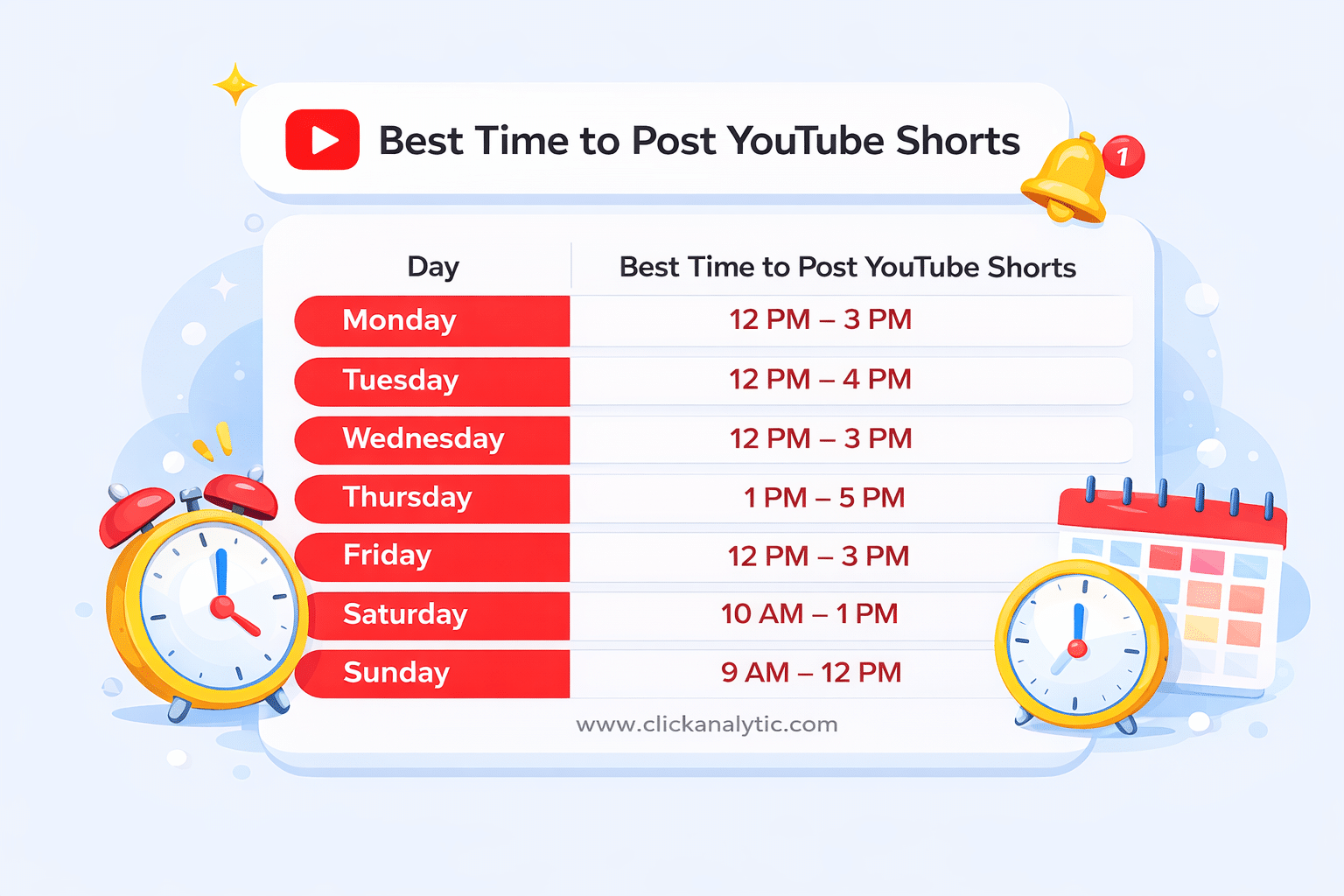
In addition to this, here’s another table of compilation data of the best time to publish on YouTube Shorts from the top online sources. Including:
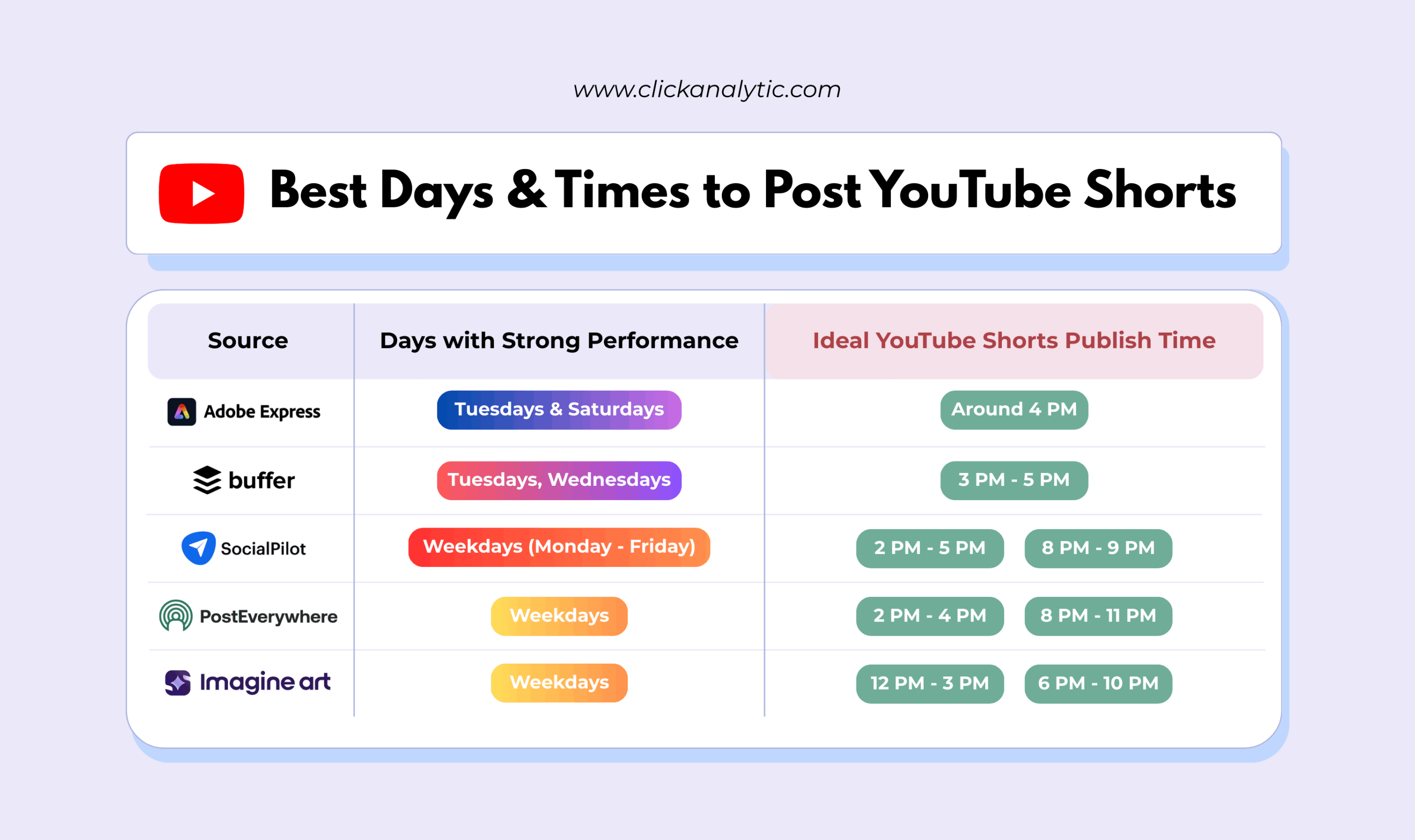
Comparing these different studies side by side, you’d find a pattern. On average, various studies point to mid-afternoon and evening time frames.
That said, avoid treating these ideal time windows as hard rules. Again, they’re only “averages” pulled from broad user behavior.
Factors like audience, niche, and location all affect whether these “hours” serve best for a niche.
So instead of chasing a single “perfect” time, why not use these windows as a starting point?
The real goal is to narrow things down using your own performance data from YouTube Studio, and not copying someone else’s chart.
That’s why we’ll now review how location and time zones may affect YOUR best time to post on YouTube Shorts
How location and time zones affect when you should post YouTube shorts
If you and your viewers are not on the same clock, posting at the “perfect” time in the wrong time zone can quietly hurt your early engagement.
As studies show, we tend to scroll during the “microbreaks” of our daily routine.
And statistics back this up:
💡 Harvard Business Review finds 77% of employees into in-work scrolling for hours a day
💡 45% of commuters say they use social media and watch videos daily during their commute
💡 Young Americans aged between 11-17 years old report using smartphones about 43 minutes during school hours
So if your upload goes live outside these ‘active times’, when your target audience is rather asleep or busy, you’re missing the crucial first push of the algorithm.
(We’re talking more about YouTube algorithm below 👇)
Here’s the best time to post on YouTube Shorts, translated by region:
🇺🇸 Best time to post on YouTube Shorts in the United States
If most of your audience is in the U.S., Shorts tend to do well in the early afternoon (2–5 PM) and again in the evening (8–9 PM local time). These windows catch lunch breaks, after-work downtime, and relaxed evening scrolling.
🇦🇺 Best time to post on YouTube Shorts in Australia
Australian viewers often check YouTube before work or school and again in the early evening. Posting between 6–9 PM AEST works well because most viewers are already slowing down and casually scrolling.
🇬🇧 Best time to post on YouTube Shorts in the United Kingdom
In the UK, midday to early evening (12–6 PM GMT) works best. Ideally, this falls between lunch breaks and post-work scrolling.
🇮🇳 🇵🇰 Best time to post on YouTube Shorts in India and Pakistan
Audiences in these regions are highly mobile-first. You want to publish Shorts when their phone usage peaks, usually within the early afternoon (1–4 PM) and late evening (8–11 PM IST/PKT).
🇵🇭 Best time to post on YouTube Shorts in Philippines
If your target viewers live in the Philippines, set post times within 12–3 PM and 7–10 PM. These times match their lunch breaks, after-school hours, and evening leisure time.
Do posting times really matter for YouTube shorts?
Yes—posting times matter for YouTube Shorts. Just not in the strict, “post at exactly 3 PM or it won’t work” way that gets repeated online.
“When you post” affects how quickly your Short gets its first real reactions.
And these first signals then help YouTube decide whether your Short is worth showing to more people.
Although this challenge isn’t new for YouTube creators. Influencer marketing studies show that many creators do struggle not because of timing alone, but because of incorrectly measuring engagement.
To understand why, let’s talk about how YouTube Shorts are actually distributed and how it works with the algorithm.
How YouTube shorts distribution really works: Passing the first 30–90 minutes
The first 30–90 minutes after publishing is when YouTube gathers your upload’s strongest early signals. Strong performance during this window helps your Short move into broader recommendation waves.
Studies further reinforce that claim. It shows that about 85% of YouTube Shorts impressions occur within the first 48 hours.
Dubs.io studies also show that posting around these strategic hours get 3x more views in the first 60 minutes, up to 45% higher watch times, and 28% faster subscriber growth.
This just clearly underscores how strategic posting influences early performance signals.
And specifically, when speaking about the best time to post on YouTube Shorts, a key factor is how the YouTube algorithm respond to it.
How the YouTube algorithm responds to timing
When you publish a Short, YouTube does not immediately push it to a massive audience. Instead, the platform starts with a small test group. Think of it like a seed rollout.
This initial rollout then helps the algorithm gauge how your audience reacts to your content.
During this testing phase, YouTube pays close attention to users’ behavioral signals like:
- Watch time and completion rate: did viewers watch most of the Short?
- Swipes vs. views: did they stay or swipe away immediately?
- Replays: did viewers watch it more than once?
These early signals influence YouTube’s understanding whether your Short is satisfying or not.
If the signals show that users love your upload, the algorithm then shows it to more people.
Now when looking at best time to post on YouTube shorts, user engagement is KEY – here’s why
Shorts can succeed hours or days after posting: User engagement vs. Ideal post times
While it’s true that early performance matters, it doesn’t lock your Short into a final outcome.
That early lift matters but it’s only half of the story.
What actually keeps a Short alive is how people react to it.
That’s how and why even days after posting, a Short can spike again if a new group of viewers watches longer, replays it, or engages with it.
Here’s the difference:
✅ Good timing helps your Short gain momentum quickly.
✅ Good content determines how far it goes.
For example, a Short posted at peak time might get fast views. But if viewers swipe away, growth stops.
Meanwhile, another Short posted later can outperform it if people watch to the end and replay it.
This explains how good post timing affects speed, but not lifespan.
Now, let’s look at the best time to post on YouTube shorts – but within a day…
What is the best time of day to post YouTube shorts?
The best time of day to post YouTube Shorts is when your audience naturally pauses and reaches for their phones.
Across most studies, those moments happen midday and early evening. Not because the algorithm says so but because of how we structure our days daily.
Midday, usually 12–4 PM, viewers catch lunch breaks and short mental resets. By this time, they tend to be distracted but curious, which makes Shorts easy to consume.
Then by early evening, around 6–10 PM, when people typically slow down and work and school are done, attention then loosens. Scrolling now turns more intentional.
But instead of asking “What time works best for everyone?”, why not narrow it down based on who you’re posting for?
As a starting point:
👉 If your target audience includes kids or parents, after school to early evening (3–7 PM) works best.
👉 If you’re targeting business owners or freelancers, try lunch breaks and evenings (12–2 PM, 6–8 PM).
👉 If your viewers are students, late afternoon through night (4–10 PM) often performs better.
These time windows aren’t rules. They’re patterns.
The real goal is to use them as a baseline, then confirm what actually works by checking your own data in YouTube Studio. That’s how you turn “best time of day” to publish on YouTube Shorts from a guess into something you can prove.
Does late-night posting still work for YouTube shorts?
Yes, late-night posting still works, if given the right audience.
If your target viewers are younger, global, or part of niche communities like gamers, posting between 9–11 PM makes sense.
Most likely within these times, they’re winding down, scrolling in bed, or killing time before sleep.
On the flip side, very late hours are not that advisable. Most people are asleep during 2–4 AM and engagement drops fast. Unless your audience lives in a different time zone.
So late night isn’t bad by default. It just works best when it matches who your viewers are and when they’re actually active.
Why off-peak times sometimes outperform peak hours
Surprisingly, off-peak hours can also work well.
Since it’s less busy, there’s less competition. So fewer creators are posting at the same time. That alone gives your Short more of a breathing room.
Posting just before a busy window also helps. This gives your Short enough time to pick up early views and signals before the busy rush starts.
This is mostly helpful if you’re in crowded niches like fashion, beauty, and fitness. Peak hours there move fast. That’s why posting slightly earlier helps your video stand out when viewers are finally online.
To spot these patterns, check YouTube Studio. YouTube Studio data can help you spot the “just before your usual spikes” times. You might be surprised when it is those in-between slots that perform better than your most expected ideal times.
Each day might also be different in terms of the best time to post on YouTube Shorts, especially if you look at different sources and studies on the web. Don’t worry, we combined them for you below.
When to post on YouTube shorts by day of the week
If you’re publishing more quick tips, life hacks, trends, or timely updates, then you’re probably posting on YouTube Shorts every day.
Knowing the most ideal hour to hit post can help your uploads get more of its deserved notice. Conversely, the wrong one can bury it fast.
Instead of pulling from a single data chart, we gathered and cross-checked data from multiple studies by Imagine.Art, Adobe Express, and Buffer.
Here’s a compilation of the most reliable posting times for YouTube Shorts by day of the week:
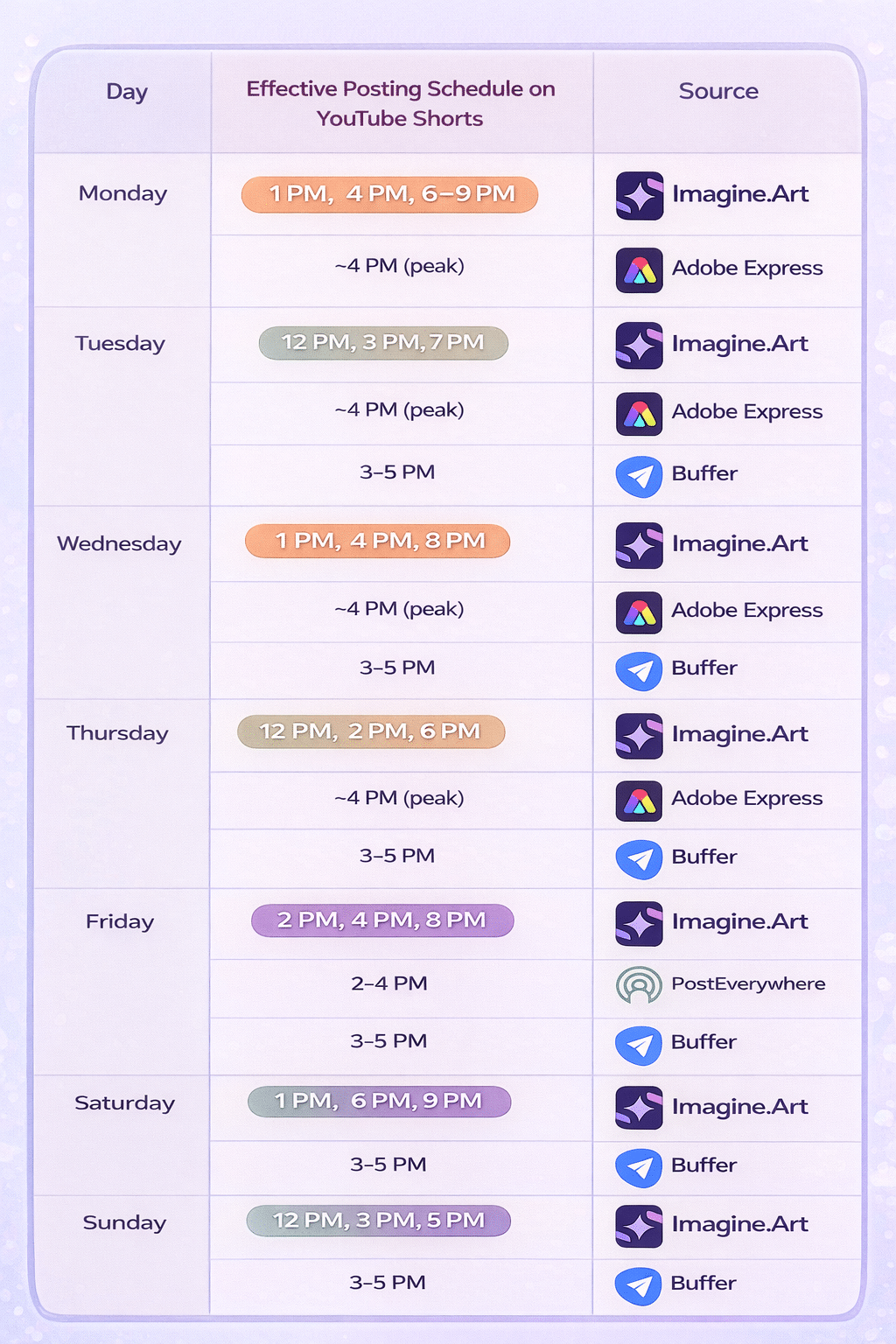
Let’s also look at the best time to post on YouTube shorts, specifically focusing per day.
🕐 Best Times to Post YouTube Shorts on Monday
👉 11 AM, 3-5 PM, 6-9 PM (~4 PM Peak)
Since Mondays tend to follow a “reset” rhythm as people ease into the week, late mornings like 11 AM work, when students and employees usually sneak in for quick mental breaks.
Later at 3-5 PM works as well, with 4 PM as the highest peak hour, and as people pick up phones when focus starts to dip mid-day before work day ends.
While evenings like 6-9 PM perform best when users are more likely home and slows down for a casual scroll before bedtime.
🕐 Best Times to Post YouTube Shorts on Tuesday
👉 12 PM, 3-5 PM, 7 PM
By Tuesday, routines start settling in. Lunch hours at 12 NN still work well.
But most engagement happens later in the afternoon between 3-5PM (~4PM still shows the strongest peak in activity) when the day is about to be called.
Evening scrolling around 7 PM, on the other hand, as ImagineArt suggests, leads to higher click-through and retention rates.
🕐 Best Times to Post YouTube Shorts on Wednesday
👉 1 PM, 4 PM, 8 PM
Midweek behavior favors short viewing bursts. Lunch hours remain strong, followed by a noticeable uptick mid-afternoon. As both studies from Buffer and Imagine.Art shows, 4 PM remains the highest peak hour.
Then, evening scrolling around 8PM performs well as people transition from work to personal time.
🕐 Best Times to Post YouTube Shorts on Thursday
👉 12 PM, 2-4 PM, 6 PM
As the weekend approaches, attention now starts loosening. And people now check their phones more often throughout the mid-afternoon.
As usual, after work early evening hours around 6PM are ideal for content designed to entertain or educate lightly.
🕐 Best Times to Post YouTube Shorts on Friday
👉 2-5 PM, 8 PM
Friday posting windows shift as routines loosen and viewers now transition into weekend mode. Similar to other weekday peak times, engagement tends to pick up in mid-afternoon.
All data sources (ImagineArt, Buffer, and PostEverywhere) suggest 2-5 PM posting windows, as people during these hours mentally check out of work or school and reach for short and low-effort content intake.
The second strong window, as ImagineArt’s data shows, appears around 8PM. This time, evening scrolling becomes more intentional and viewers are more likely to watch through, replay, and engage.
🕐 Best Times to Post YouTube Shorts on Saturday
👉 1 PM, 6 PM, 9 PM
Weekends favor relaxed, optional viewing. Data shows that engagement tends to pick up around early afternoon around 1PM. This time window is when people are easing into the day and casually checking their phones between activities.
Second lift in engagement then comes around 6PM and then 9PM. Evening downtime now sets in and Shorts benefit from longer watch time and replays.
🕐 Best Times to Post YouTube Shorts on Sunday
👉 12 PM, 3 PM, 5 PM
Sundays start slow and build gradually. Scrolling activity typically begins around late mornings, around lunch time at 12 PM. This time, viewers are transitioning from weekend morning routines into light midday browsing.
At 3 PM, engagement again strengthens as people take longer breaks and consume more intentional scrolls.
Then a final spike most often appears around 5 PM, as viewers are mentally shifting towards the upcoming week and settle into early evening downtime.
When considering the best time to post on YouTube Shorts, there is also a notion of weekday vs weekend.
Weekday vs weekend YouTube shorts posting strategy
For content creators, understanding when to post is only half the strategy. The other half is knowing what mindset your audience is in on different days.
This is where your YouTube Shorts content planning strategy comes in.
Viewer intent shifts noticeably between weekdays and weekends. Aligning your content to that intent can improve performance during your Shorts’ first 48 hours.
How viewer intent changes by day
On weekdays, most viewers are in a task-oriented, distracted mindset. They scroll in short bursts during lunch breaks, mid-afternoon dips, or after work.
This makes weekdays ideal for quick tips, micro-tutorials, hacks, and concise insights. Think of content that delivers value fast without demanding much mental energy.
Passive scrolling vs active engagement windows
Weekends, on the other hand, bring more passive but open-ended browsing. Viewers have more time and are less rushed, especially in the mornings and evenings.
This is when content like storytelling, lifestyle, entertainment, and slightly longer Shorts tend to perform better. Since it’s the weekend, people are more willing to watch through and re-engage.
Compared to Saturdays, Sunday engagement tends to be steadier rather than spiky. Given this behavior, Sundays make a strong posting day for evergreen, reflective, or educational YouTube Shorts that benefit from calmer viewing behavior.
Adjust content type by posting day
Given this psychological and behavioral context of viewers, it’s not enough to post YouTube shorts at the right time.
To improve hooking your audience, post the right type of content for the day.
Use weekday peak times to publish utility-driven Shorts that solve a quick problem. Save weekends for exploratory, personality-driven, or evergreen content that benefits from relaxed viewing.
What are the best times to post YouTube Shorts for views?
If you’re chasing views, also chase publish times when the crowd is already scrolling.
In general, you’ll see the biggest reach when you post in the mid-afternoon to early evening on weekdays, and late morning to early afternoon on weekends.
That’s when YouTube traffic is high and your Short has more chances to get picked up and shown to new people.
But here’s the catch, discovery timing isn’t the same as engagement timing.
During busy hours, people tend to scroll fast. People watch more YouTube videos, but they’re less likely to stop, comment, or interact.
So yes, you might get views, but not always deeper engagement.
That’s why “views-optimized” times aren’t always best for growth. Peak hours are crowded, and your Short can get lost in the noise.
What are the best times to post YouTube shorts for engagement?
Studies across YouTube and broader social media platforms show that engagement tends to rise when people are mentally transitioning. This mental transition usually happens during lunch breaks, late afternoons, or early evenings.
At these times, viewers aren’t in a rush. They’re more relaxed, emotionally receptive, and more likely to interact with content they enjoy. This is why likes, comments, and shares often cluster between 2–5 PM and once again in the early evening.
Interestingly, posting on comparable social platforms like Facebook and Twitter show that posts published within optimized times receive up to ~17% more reactions than those posted on random hours. It’s reasonable to expect similar audience behavior patterns to influence early engagement on YouTube Shorts as well.
On the flip side, engagement doesn’t always peak during the busiest viewing hours. In some cases, off-peak times produce higher engagement rates because the audience is smaller but more attentive, and there’s less competition from other creators.
Best time to upload YT shorts based on your audience and niche
It doesn’t mean that if 7 PM works great for someone else, it’s automatically the best time for you too.
The best time to post YouTube Shorts depends on who your audience is, what they’re looking for, and why they’re scrolling at that moment.
Like radio shows, a late-night talk show and a morning news segment don’t compete for the same listeners. Instead, they show up when their audience is actually tuned in.
YouTube Shorts work the same way. Different people scroll at different times, for different reasons.
That’s why posting time isn’t one-size-fits-all.
Below is a breakdown of three of today’s most common and profitable content niches in YouTube Shorts and how their audiences behave differently throughout the day.
🍿 Entertainment and pop culture
Best times to publish YouTube Shorts: 3–5 PM & 7–9 PM
Entertainment-driven audiences scroll YouTube Shorts primarily to be ‘entertained’. They want to relax, be amused, or keep up with trends.
These viewer behaviors peak after work or school when mental effort is low and passive consumption is high.
They call this “mental checkout” moments when the day is about to end around 3 PM–5 PM. Also, before bedtime around 7 PM–9 PM more align with leisure time. Calling it a day, viewers are more likely to watch multiple Shorts in a row, replay clips, and share trending content.
🧑🏫 Educational and how-to content
Best times to publish YouTube Shorts: 11 AM–2 PM & 6–8 PM
Educational viewers are more goal-oriented than casual browsers. And they engage more when they have the mental bandwidth. Think of lunch breaks and times when daily responsibilities wind down.
Midday uploads (11 AM–2 PM), for instance, perform well because during this time, viewers with educational intent look for quick, practical insights without the long time commitment.
Evening uploads (6 PM–8 PM), on the other hand, work because learners are now more focused and willing to absorb information.
🏃♀️ Lifestyle and fitness
Best times to publish YouTube Shorts: 6–9 AM & 9–11 AM (weekends)
Lifestyle and fitness content is closely tied to daily routines.
For example, 6 AM–9 AM morning hours perform best on weekdays because viewers are possibly planning their day, squeezing in quick workouts, or seeking some needed motivation to get started.
Conversely, on weekends, engagement shifts later into the morning when people have more flexibility and time to explore wellness content without the rush.
Posting strategy isn’t the same for small and large channels ❌
If you’re a smaller or newer channel, don’t play the same game as big creators.
In fact, breaking the ‘ideal’ and posting slightly outside peak hours works in your favor. Because during these off-peak times, there’s less noise and fewer channels fighting for attention.
Moreover, large creators usually dominate the peak hours. Understandably, they already have a list of subscribers waiting. Not to mention the algorithm “knows” their content performs. That means their Shorts get early engagement almost automatically.
If you’re still growing, this can make it tougher for you to get those important first signals (views, watch time, and engagement) that help your Shorts take off.
Small businesses, for instance, now increasingly use targeted influencer collaborations to connect with specific audience segments. Although this strategy needs a good understanding of factors like timing and niche behavior. Our guide on influencer marketing for small businesses specifically highlights how you can do this.
On the flip side, if you’re a larger channel, peak hours make more sense. Since your audience shows up for you no matter what, your uploads can perform even when competition is high.
Whichever category your channel belongs to, choose your YT Shorts posting time based on where you’re at, and not on just what the charts say “this works”.
How many YouTube Shorts should I post per day?
YouTube doesn’t give you a magic number for how many Shorts to post. And that’s intentional.
According to Google Help, what really matters in YouTube Shorts is frequency and consistency. Posting on a regular schedule helps your audience know what to expect and tells YouTube your channel is active.
You don’t have to post as much as possible to become more visible.
Most successful creators suggest finding the rhythm you can sustain and stick with long-term without burning out or cutting corners.
Molly-Mae, a £ multi-million brand empire influencer, for instance, shows how long-term consistency built over years matters more than occasional bursts of attention. Her growth on YouTube isn’t founded on random videos, instead she built her channel on a rhythm of uploads that build connection and familiarity. The very essence of developing trust with viewers.
How about you?
For most creators, a smart place to start is 1 YouTube Short per day. That’s enough to learn what your audience responds to. Study what hooks grab attention, which topics land, and which times work best.
Once you’ve got your system down, you can then test 2 Shorts per day, ideally spaced out (like one at midday and one in the evening).
Some creators go up to 3 per day, but that usually works best when you already have strong demand and a smooth content workflow.
Posting more isn’t always better ❌
Posting too many YouTube Shorts too close together can backfire, especially if you’re still growing.
Your YouTube videos can end up competing with each other for early views and engagement.
Bottom line? Quality beats quantity.
If posting more starts to lower watch time or engagement, that’s your cue to slow down. Consistency you can maintain will always win over going all-in and burning out.
Now, let’s look at the key steps to find the best time to post on YouTube Shorts!
How to find your best time to publish on YouTube shorts
All the “best time to post” charts you’ve seen so far are helpful. At least as a starting point.
To truly figure out what actually works for you, you need to look at your own audience data. And the best place to do that is YouTube Studio.
Start with YouTube studio audience insights.
Go to YouTube Studio → Audience and look for the chart that shows when your viewers are on YouTube.
This tells you when your audience is actually active, not when generic studies say they should be. This is your home base.
Know the difference between peak activity and peak performance.
Peak activity means traffic is high. Peak performance means your Shorts get better watch time, replays, and engagement.
And that difference matters.
Just because more people are online doesn’t directly mean your Shorts will also perform.
As mentioned, consider your channel and subscribers’ size, and what your YouTube Studio data says “when”.
In some cases, posting slightly before or after peak hours works better because there’s less competition and viewers tend to be more focused.
Focus on the metrics that really matter.
Don’t get stuck staring at views alone. Views does not equate to engagement.
For Shorts, pay closer attention to average view duration, completion rate, replays, and early engagement.
Notice certain posting times that consistently gain more engagement. These time windows are your real best time to post on YouTube Shorts.
If you want a quicker way to evaluate how well your Shorts are performing, try our free YouTube engagement calculator. This tool is built to help you benchmark likes, comments, and views against your posting times.
How to test and optimize your YouTube Shorts posting schedule
After picking a few posting times to try, test them the right way.
However, avoid changing too many things at once.
If you’re testing posting time, keep everything else steady. Keep the same type of content, similar length, similar hook. Otherwise, you won’t know what actually moved the needle.
Give your tests enough time to breathe
Don’t judge a time slot after one upload.
A good rule of thumb is to test a specific posting time for 1–2 weeks or around 6–10 Shorts.
This allows a ‘reasonable time frame’ for you to actively spot real patterns instead of passively reacting to random spikes or dips.
Watch the right numbers
Views are nice, but they don’t really tell the whole story. You want to focus more on the “actions” taken instead.
For instance, focus on:
- Retention and completion rate (are people watching till the end?)
- Engagement (likes, comments, shares)
- Velocity (how fast views come in during the first 30–90 minutes)
YouTube cares more about these signals than the views count.
However, one viral Short doesn’t mean you’ve already cracked the code. One flop doesn’t also mean your post time is bad.
Again, take the time … Look for trends across multiple posts.
Remember that optimization is about spotting patterns, and not chasing every win or loss.
Another free tips that I would like to share is that you can use many tools to find the best time to post on YouTube Shorts. I will list them below for you!
Helpful tools to schedule and analyze YouTube shorts
For many creators, keeping things simple works. A stack of fancy tools may help, but they don’t guarantee success.
Native scheduling tool: YouTube Studio
If you’re posting mainly on YouTube, YouTube Studio may be enough to schedule your videos and Shorts in advance.
With it, you can set an ideal publish time and track performance (analytics and data) all in one place.
This native tool is straightforward, reliable, and keeps your data clean. For solo creators or small teams, this is often all you need.
For example, on our YouTube channel, most of our viewers are active on Monday and Friday’s at 4pm and 6pm CET, as shown in our YouTube Studio analytics below. 👇
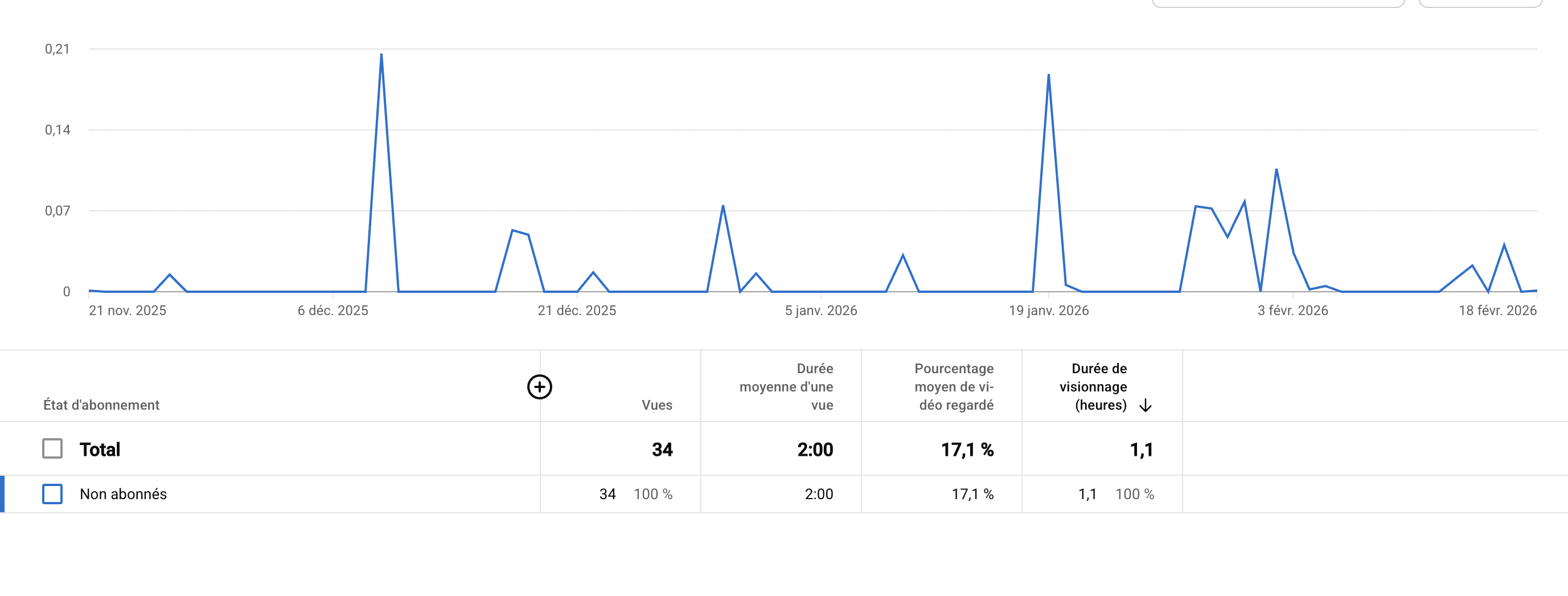
A line graph highlights video view spikes over time from November 2023 to February 2024, with insights on the Best Time to Post on YouTube Shorts, plus stats for views, average view duration, and watch time among non-subscribed users.
You can find the same data for your channel by going to YouTube Studio → Analytics → Audience → “When your viewers are on YouTube.”
When third-party YouTube scheduling tools help
Third-party tools for schedule automation only make sense when you’re a freelancer managing multiple client accounts, juggling multiple platforms, managing a content calendar, or working with a team.
They’re also helpful for batching content, planning weeks ahead, and keeping everything organized.
Tools like Buffer and Hootsuite are popular tool choices for scheduling YouTube content, including Shorts.👇
However, you can’t expect them to drastically improve views, likes, and saves.
As a tool, they help you stay efficient. But they cannot bypass algorithm hacks.
YouTube scheduling tools can only help you save time, but they cannot think for you. As usual, solid data and analytics should guide your posting decisions and strategy.
Many marketers and creators will often make the same mistakes when looking to find the best time to post on YouTube Shorts. Let’s review those below.
5 most common timing mistakes that kill YouTube Shorts performance
Most of the time, it’s not your timing alone that’s keeping your YouTube channel buried. It’s how you’re using (or misusing) it.
Here are 5 of the most common mistakes that can quietly hold your YouTube Shorts back.
1. Relying only on “best time” charts
Best-time charts are helpful, but they’re only averages. No guarantees. If you follow them blindly, you’re basically wearing someone else’s shoes and hoping they fit.
Use charts as a starting point, then test and adjust based on how your audience actually behaves.
2. Ignoring your audience data
Your YouTube Studio data will always be more accurate than generic studies.
If your audience is active at times that don’t match the “recommended” windows, trust your numbers.
3. Changing schedules too frequently
Switching posting times every few days makes it impossible to see patterns. Shorts need repeated data to show trends.
Pick a time, stick with it for at least 1–2 weeks, then evaluate. Consistency gives you clarity.
4. Posting inconsistently and blaming timing
If your uploads are random, timing won’t save you. Inconsistent posting trains neither your audience nor the algorithm.
Before blaming the clock, make sure your schedule is steady enough to be tested fairly.
5. Posting without considering content–time fit
Even if you post at the “right” time, the timing won’t help if the content doesn’t match the moment.
If your audience is tired, distracted, or casually browsing, keep things light and snackable. Save deeper, instructional Shorts for times when people are more focused and willing to watch through.
The best time to post on YouTube Shorts is the one you can prove
After all the charts, studies, and “best time” recommendations, here’s the honest truth: there is no single perfect posting time that works for everyone.
The best time to post on YouTube Shorts is the one you can actually prove works for your audience.
Yes, afternoons and evenings tend to perform well. Yes, timing affects early momentum. But timing alone won’t save weak content, and copying someone else’s schedule won’t suddenly unlock growth.
What really works is combining good content, consistent posting, and real testing.
Creators who grow long-term don’t guess. They check YouTube Studio, test a few posting windows, watch the right signals (retention, engagement, early velocity), and stick with what shows up consistently. They don’t panic over one bad post, and they don’t chase every new “best time” chart online.
If you want a simple next step, do this:
Pick two to three posting times, test each for one to two weeks, keep your content style steady, and review the results calmly. When a pattern shows up, lock it in.
The best posting time isn’t the most popular one. It’s the one backed by your data.
Finally, as it may be helpful – I’ll share the most common FAQs on the topic: best time to post on YouTube Shorts.
FAQ Section
What is the best YouTube Shorts posting time?
The best posting times for YouTube Shorts are 12-3 PM and 7-10 PM (your audience’s local time). These time windows align with typical viewers’ break times and evening downtime, times of the day when users are most likely to scroll and engage with short-form content like YouTube Shorts, reels, and TikTok.
Does YouTube Shorts algorithm timing matter?
Definitely. YouTube Shorts algorithm timing influences early engagement of uploads. The YouTube algorithm closely evaluates Shorts’ performance within its first 30-90 minutes after posting. Metrics and signals like watch time, completion rate, and replays majorly decide whether your Shorts deserve much wider distribution or not.
How to schedule YouTube Shorts?
YouTube Studio can help you schedule YouTube Shorts directly without leaving the platform.
Upload your Short, choose a schedule, and set a publish date and time. Most creators choose this tool because it’s native, reliable, and has built-in analytics.
You can also make use of third-party scheduling tools like Buffer and SocialPilot. However, if you’re a small channel and yet starting, YouTube’s native studio tool may suffice.
Third-party scheduling tools make sense if you manage multiple channels, platforms, and batch content weeks in advance. These specialized scheduling tools help you manage workflow and organisation; but they do not directly improve your channel’s reach or bypass any YouTube algorithm hack.